GEORGE EDWARD STUART (1851 – 1925)
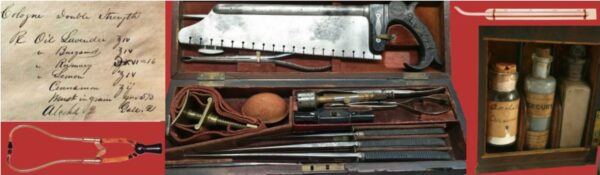
An index card, and old paper note, and newspaper clippings were found with in set when it was purchased. The pencilled note is written on a scrap of paper, and states that the set was formerly the property of Dr. Charles Stuart, and that his father, George Edward Stuart (1851 – 1925) had used the set during his practice in various small communities in Oregon. It also states that the set was originally the property of “a physician practicing in Oregon City prior to Dr. Stuart’s arrival there.” This is a clue which may allow attribution of the set as originally belonging to a Civil War surgeon.
George Edward Stuart was born in Canada in 1851, and by 1870, lived with his family to Webster City, Iowa. As a young man, he worked in a physician’s office in Webster City and completed a medical course. After the death of his employer he succeeded to the practice but was unable to withstand the constant exposure to the elements and sought an indoor occupation, becoming a photographer. He married Ora Spangler and their son Charles Albert Stuart was born in 1876. He was persuaded by his brother to move to Oregon City, Oregon some time after 1885. He practiced medicine in Pendleton, Oregon for about a year, then lived in Oregon City before moving to Dayton, Oregon. Various biographies states that he worked as a photographer, and also “practiced medicine” during this time.
When Stuart moved to Oregon, he had very little formal education in medicine, and did not have a medical degree. He decided to resume his medical studies again and enrolled in the “Independent Medical School of Chicago” (which was not an accredited medical school, it was a mail-order “diploma mill”). He “graduated” from this school in 1890. He practiced in other small communities in Oregon: Bonanza, Monument, North Yamhill, Newberg, before moving back to Oregon City in 1914 to join the practice of his son, Dr. Charles Albert Stuart. About 1914, he returned to Oregon City, where he practiced another ten years alongside his son. His health eventually deteriorated, and he died from the after-effects of a fall on October 24, 1925.
ATTRIBUTION OF THE SET (ORIGINALLY )TO A CIVIL WAR SURGEON
In the 1880’s Oregon City was a small community. There are two sources that list the physicians practicing in the town during this time. One is a contemporary research paper written by William R. Laird that details the names of all physicians who practiced in Oregon City over the decades. The other is a directory published by R.L. Polk & Co. that lists all the practicing physicians in the United States for the year 1886. Each of these resources shows a handful of physicians practicing in Oregon City in 1886. But only one was a surgeon during the Civil War. He was born into a prominent family, attended Harvard Medical School, lived in New York City after the close of the Civil War, and had the financial means and access to a set of this quality.
SCOLLAY PARKER, M.D. (1839 – 1909)
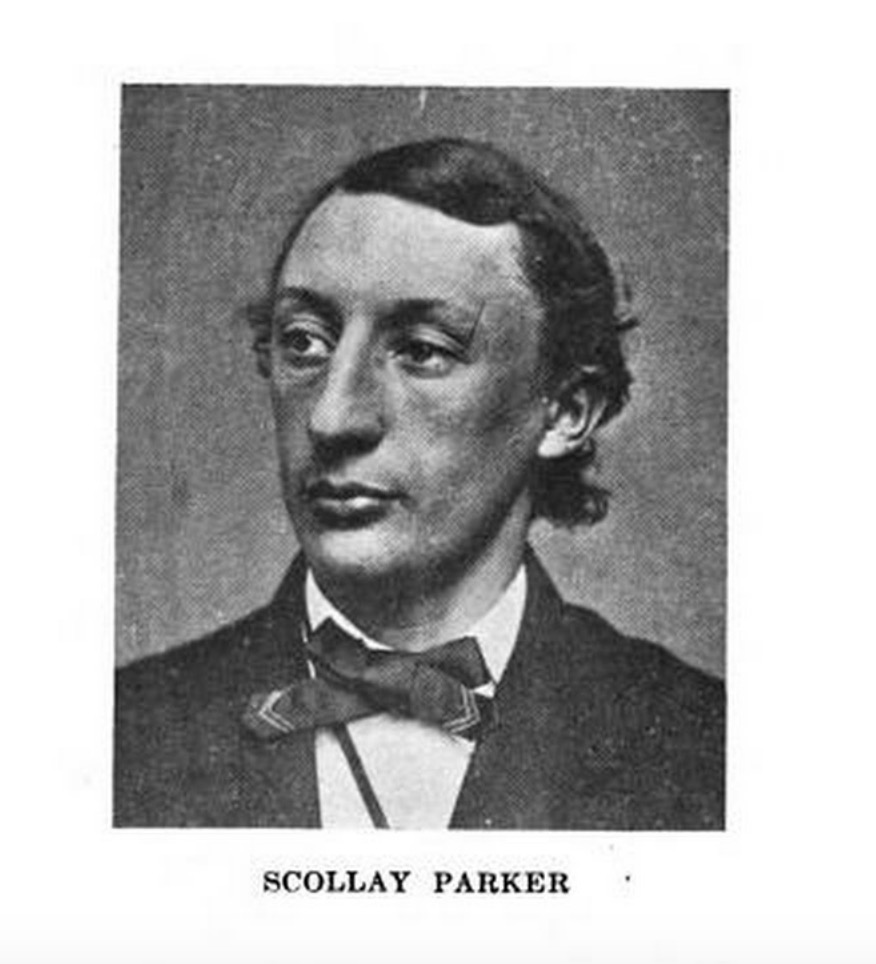
Scollay Parker was born in Georgia in 1839. His father was a prominent engineer for Boston area railroads, and his mother was the granddaughter of William Scollay, for whom Scollay Square in Boston is named. Parker attended Boston Latin School and graduated Harvard College in 1861. He briefly studied at Harvard Medical School, but his studies were interrupted by the Civil War. In April 1861, he became a hospital steward and from June – July of 1862, served in the U.S. Sanitary Commission aboard various hospital transport vessels, including the “Daniel Webster”.
In September 1863, he was appointed Acting Assistant Surgeon, U.S.N., and was ordered to report to Admiral Porter of the Mississippi Squadron in Cairo, Illinois. There he was named chief medical officer for the tinclad U.S.S. Rattler, then patrolling a part of the river from Natchez to Vicksburg. He was detached from the Mississippi Squadron in June 1864, and assigned to the U.S.S. Glaucus, then in 1865, to the U.S.S. Isonomia.
In 1866 he was granted his medical degree from Harvard University. After passing the necessary examination (see below), he was promoted on May 15, 1866 to Acting Passed Assistant Surgeon in the U.S.N., Gulf Squadron. After experiencing a slight case of yellow fever that August, his resignation from the Navy was accepted in August 1866 “to take effect on reporting of relief.” His resignation was revoked, and was instead granted three months leave of absence in October 1867. He received his discharge from the U.S. Navy on January 19, 1868.
Dr. Parker practiced sporadically in Oregon City and Portland during the years 1874 – 1887. He began practicing in Oregon City in May 1874, and there are numerous ads he posted in the local paper (the Oregon City Enterprise) throughout that year. From articles in the newspaper, there is evidence that he moved back and forth between Portland and Oregon City between the years 1875 – 1883. He was the Clackamas County (Oregon City) coroner in 1883.
According to his biography, he opened a drug business in Portland in 1884 “practically abandoning general practice”. Yet, in the 1886 Polk Directory, he is listed as practicing in Oregon City. In 1890, he is listed as practicing in Portland. He left Portland for San Francisco in 1892 where he attended pharmacy school, graduating in 1893. He returned to Portland in 1894 and stayed through 1905. According to an affidavit filed by his wife for Widow’s Pension, he was too ill to do much work at all for about 10 years before his death in 1909.
Dr. George Edward Stuart practiced in Oregon City at the same time as Parker was essentially ending his practice. It is quite plausible that Parker was the physician who gave this surgical set to Dr. Stuart.