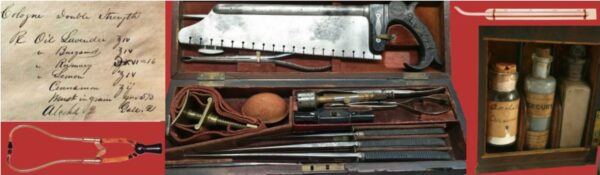
Rare Confederate Hospital Linen Sheet Marked U.S.A. Hospital Department
RARE CIVIL WAR CONFEDERATE HOSPITAL LINEN SHEET MARKED
“U.S. ARMY HOSPITAL DEPARTMENT” BROUGHT HOME BY
CONFEDERATE HOSPITAL STEWARD MUSCOE GARNETT (1832 – 1922)
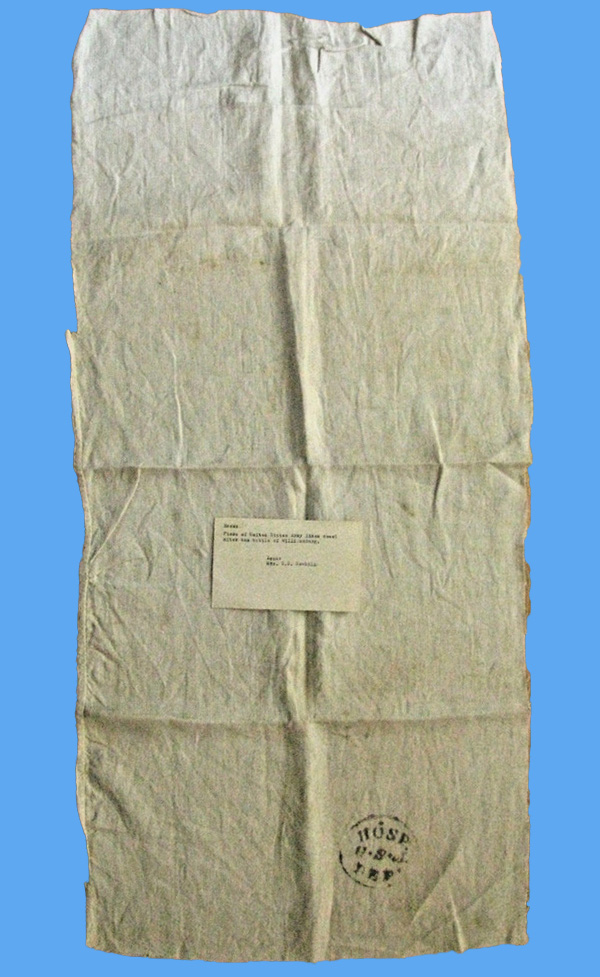
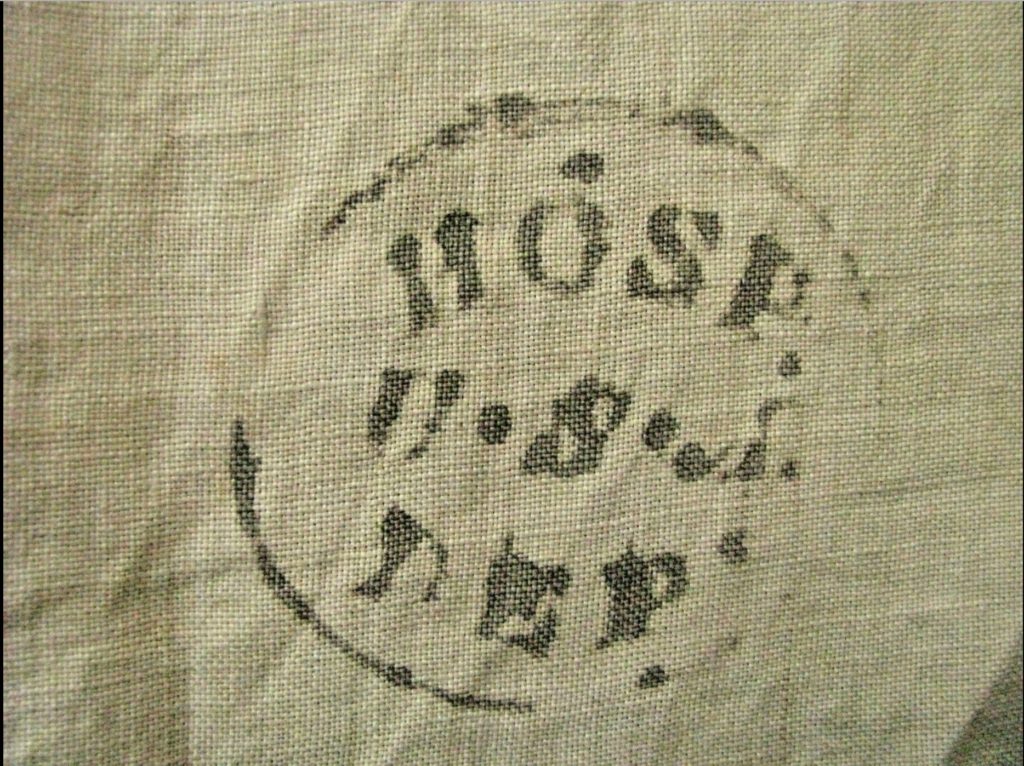
This is a very rare and one-of-a-kind item, with fantastic provenance. It was obtained from the estate of the daughter of Confederate veteran and former Hospital Steward Muscoe Garnett Jr., of Essex county, Virginia. It is a large fragment of a linen hospital sheet, measuring 36 by 16 inches in size, with a round black stamp measuring 2.5 inches in diameter: “Hosp. Dept. USA”.
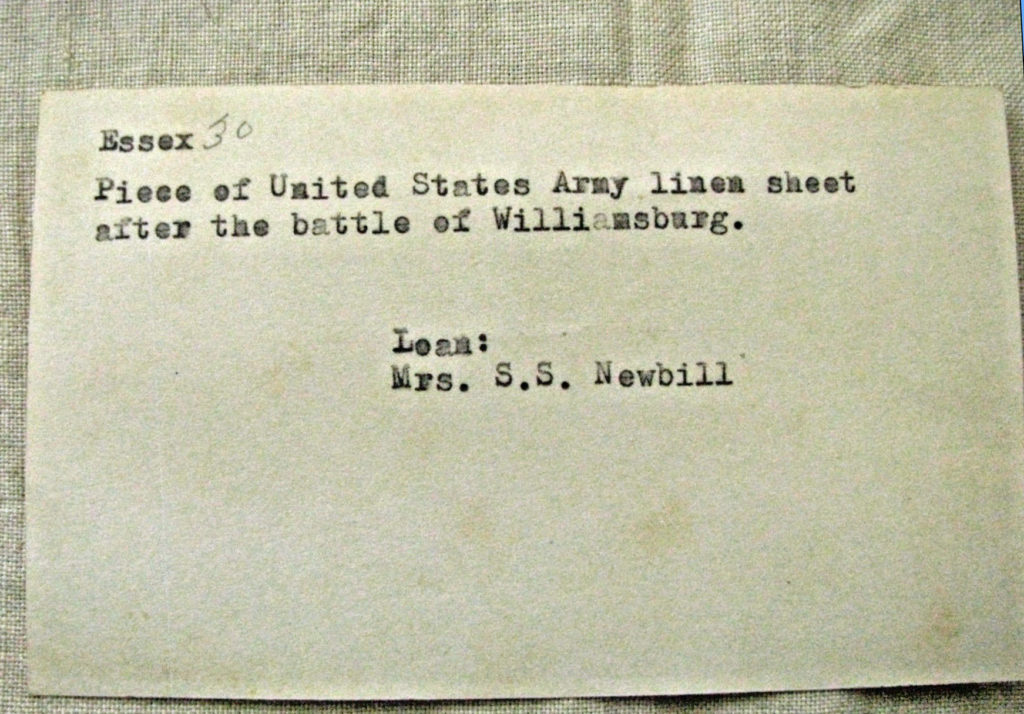
The card accompanying the sheet is from the time of the Civil War Centennial, c. 1961, and documents that the sheet was loaned for a display by Mrs. Sydney Smith Newbill. Mrs. Newbill was Vanangus Amelia (“Vay”) Garnett Newbill – the youngest child of Muscoe Garnett, Jr. “Vay” was born in 1886, the second of two daughters born to Muscoe Garnett, Jr. and his wife, Vanangus Amelia Dobyns Garnett. She died in 1967, several years after contributing this piece to Essex county’s Centennial exhibition.
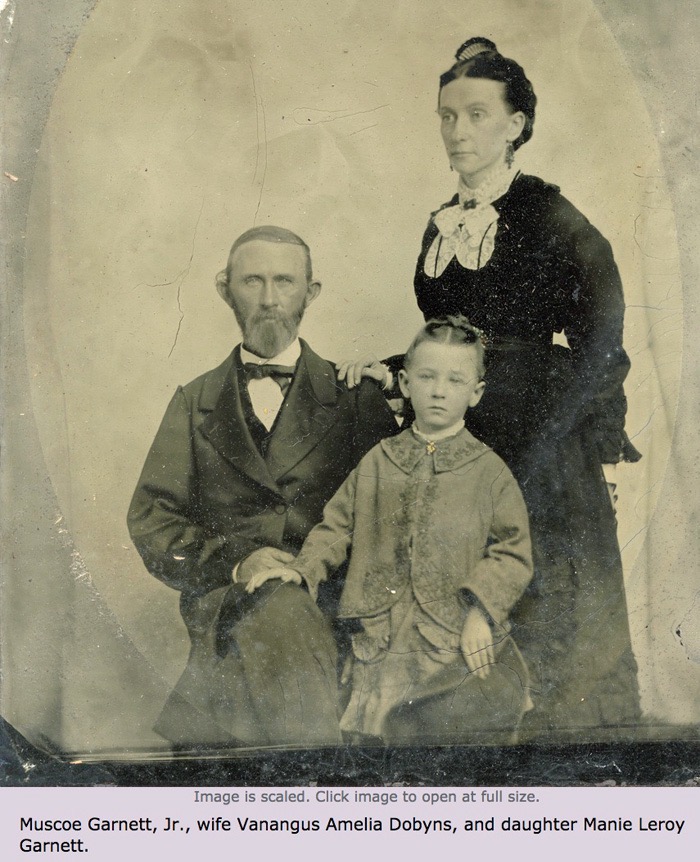
ABOUT MUSCOE GARNETT, JR. 1832 – 1922
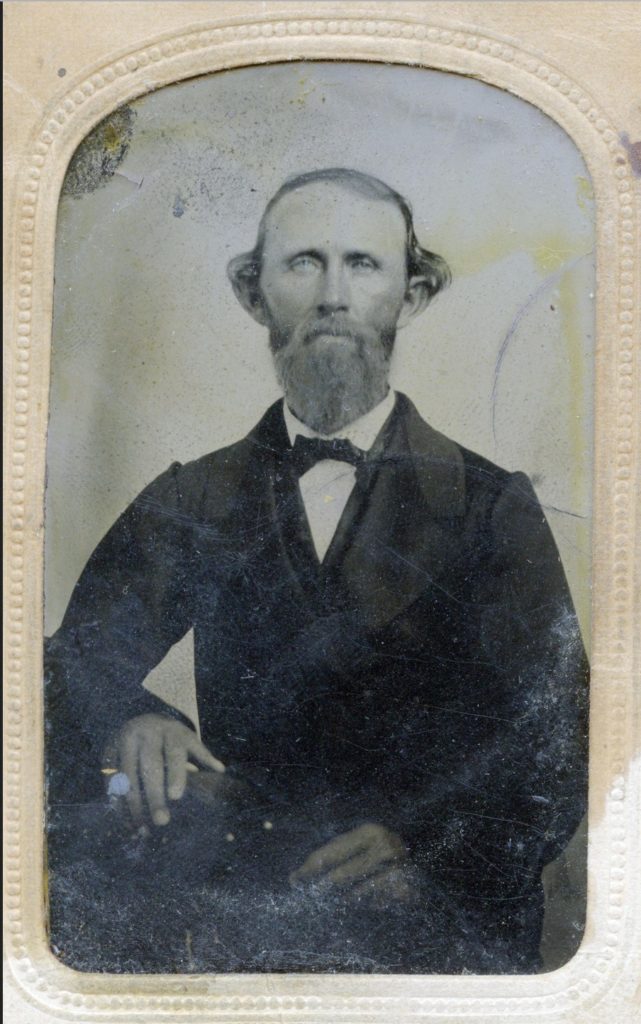
Muscoe Garnett, Jr. was born on January 1, 1832 at “Farmer’s Retreat” in King and Queen county, Virginia. He was the second son born to Muscoe Garnett and his first wife, Sarah Booker Garnett. When Muscoe was five years of age, his mother died. His father remarried, and his new family lived in her father’s home, Ben Lomond, in Essex county. The senior Garnett was a lawyer, and wealthy – with much influence in Essex county and the region. In 1850, he was a member of the Constitutional Convention and helped revise Virginia’s Constitution. For seventeen years he was a member of the Virginia House of Delegates. In 1879, he became Judge of Essex County. During the Civil War, he was commander of the Home Guard. The region where Garnett lived was steeped in loyalty to the cause of the Secessionists. On February 1st, 1861 the citizens of Essex County instructed their delegate to the Secession Convention to “distinctly understand that we desire the Convention to entertain no proposition for compromise or arrangement with the non slave-holding States. Put Virginia out of the Union and into the Southern Confederacy…” By 1879, elder Garnett was Judge of Essex County.
Muscoe Jr. did not follow in the footsteps of his father and older brother Lewis and become a lawyer, nor follow his younger brother David into medicine. He became a farmer, and entered public life in Essex county, serving in the capacities of deputy sheriff, assessor of lands, deputy treasurer and constable. He was “always active and diligent in the discharge of the duties of the office” from 1869 – 1912. He married Miss Vanangus Amelia Dobyns on December 22, 1870. He fathered two daughters, Manie Leroy Garrett (1871 – 1960) and Vanangus Garnett Newbill. The last ten days of his life was fraught with the most intense suffering, caused by a fall in his room, which fractured his hip. He passed to his reward on August 3rd, 1922, at 3:20 o’clock with his loved ones around him, was buried on August 5th at Cottage Park by the side of his wife who preceded him ten years.
MUSCOE GARNETT JR. IN THE CIVIL WAR 1832 – 1922
Trying to put together the information on the index card accompanying the sheet with Muscoe’s service is like putting together a puzzle without the satisfaction of ever knowing the true answer. We start with some facts: the Battle of Williamsburg took place May 5, 1862. It was the first pitched battle of the Peninsula Campaign, fighting an inconclusive battle that ended with the Confederates continuing their withdrawal. Where was Muscoe Garnett, Jr. at this time? Fortunately, Confederate service records exist, giving us a detailed account of his service.
Muscoe Garnett, Jr. was a 29 year old farmer when he enlisted with the rank of Private in Company F (the “Essex Sharpshooters”) of the 55th Virginia Infantry on June 7, 1861. While he was enlisting in the 55th, his older brother Lewis Henry Garnett, and younger half-brother, Frank Buckner Garnett, enlisted in company F (the “Essex Light Dragoons”) of the 9th Virginia Cavalry. Although the 55th would go on to participate in many battles for the remainder of the war, Garnett left the unit before its first engagement, deciding to join his brothers in the 9th Virginia Cavalry on March 19, 1862.
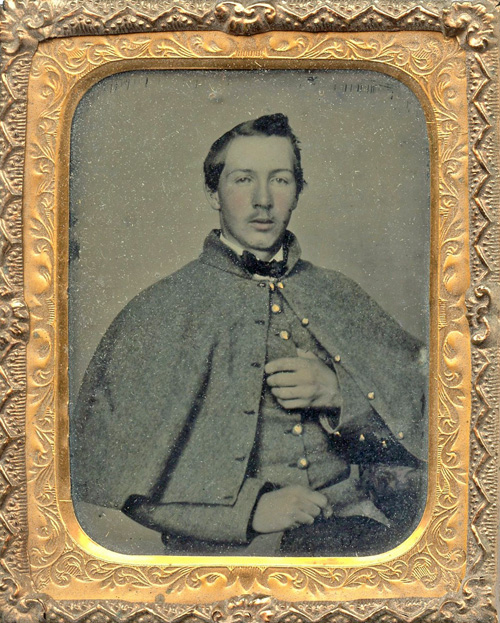
When Garnett joined his brothers in the 9th Virginia Cavalry, it was still “green”, engaged in guard and picket duty in the area of Fredericksburg, Virginia. Oddly, the regiment did NOT participate in the Battle of Williamsburg. It was not until June 27, 1862 when it had its first engagement with the enemy at Mechanicsville, Virginia. Muscoe is listed as “present” on the muster rolls for May and June of 1862. But after June 30, he is listed on “detached service as a Hospital Steward in Richmond.”
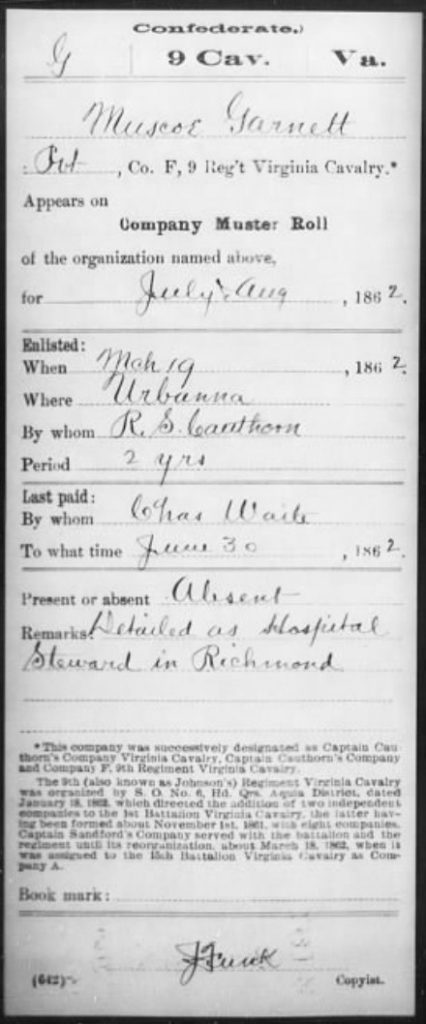
The reason for this change in duty may be directly related to the fact that his 19-year-old brother Frank had become ill with typhoid fever and on June 20th was transferred to a hospital in Richmond. Did Muscoe make a request to accompany him to the hospital? We can only speculate – and note that the rolls reflect that he was made a Hospital Steward on August 12, 1862, “by appointment of the Secretary of War.” What role Muscoe Garnett, Sr., a lawyer, may have had in expediting this transfer is unclear. Muscoe Jr.’s first assignment was at General Hospital No. 23 in Richmond – formerly the John L. Ligon tobacco factory – and that may be the hospital where Frank died on July 6, 1862. General Hospital No. 23 in Richmond is the building to the right of Moore Hospital in the photo below:
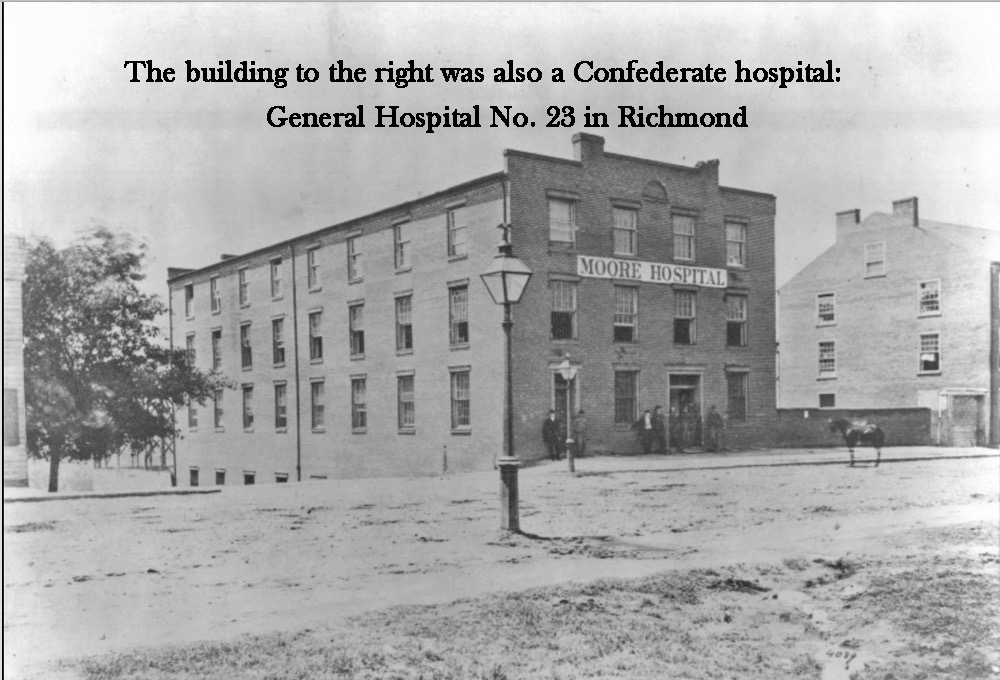
While working at General Hospital No. 23, Muscoe would have encountered soldiers who were recovering from injuries sustained from the battles of the summer of 1862 – including the battle of Williamsburg. Was it at this time that he obtained his hospital sheet “souvenir”? Perhaps it was part of the sheet that had covered his dying brother (a grisly, but not unrealistic, possibility.) The Confederate records indicate that Muscoe served at the General No.23 from August 1862 to the end of June, 1863. In April 1863, Muscoe is listed as “in charge of Guard of the Hospital Property”. His nearly one year term there expired, and on July 1, 1863, he reported for duty to Jackson Hospital, a hospital for the Third Division of the Confederate States Army.
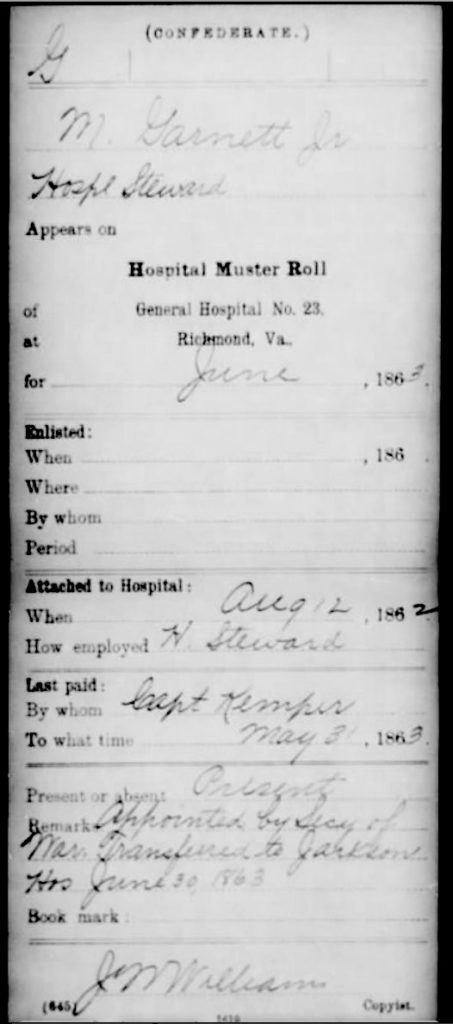
Jackson Hospital (named for General Thomas J. “Stonewall” Jackson) had opened its doors two days earlier, on June 29, 1863. It was also located in Richmond, “in the Western suburbs beyond Hollywood Cemetery…midway between Camp Lee and Winder.” Originally composed of 49 buildings capable of handling 1980 patients, it was reportedly later enlarged to a capacity of 2500. A common military road joined it with Winder Hospital. It had 40 acres of gardens and a military library, and a large staff – from among its “employees”, three companies of African-American troops were furnished for Confederate service.
Shortly after his arrival at Jackson in September 1863, he was ordered to report for a Hospital Steward exam. Hospital Stewards were not necessarily medical students or apothecaries – though many were. Despite the term, Hospital Stewards also included men with no medical or pharmacy training. Some stewards also acted as key managers of a hospital, supervising the wardmasters and nurses. The surgeon-general of the C.S.A. mandated exams of all Hospital Stewards; these were held at General Hospital No. 10 in Richmond, in front of a board of three surgeons. The exams were done to assess not only the physical and moral character of the stewards, but also their skill set – whether it be as an apothecary or in a managerial position. Some men previously serving as a Hospital Steward were rejected from further service. It was a plum position – a circular from the Surgeon-General’s office in 1864 stated that stewards “were the only able-bodied white men between the ages of seventeen and forty-five employed in hospitals who were exempted from field duty.”
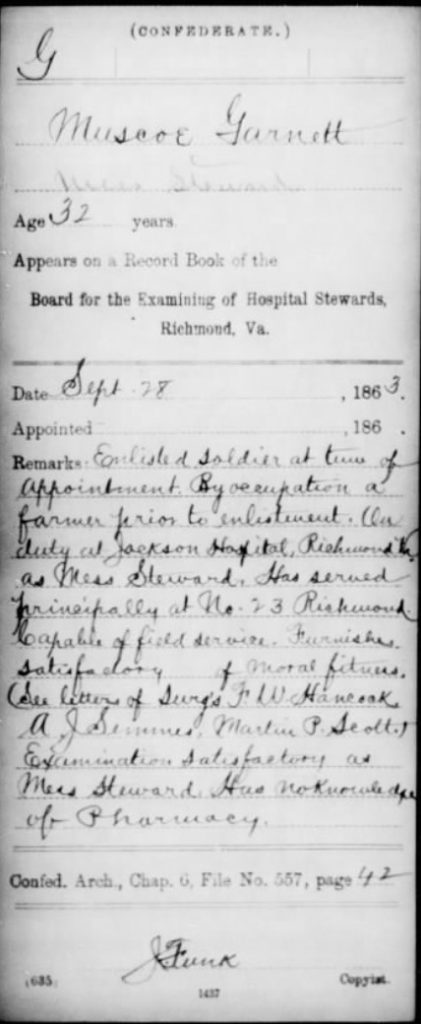
As noted in the record above, the examining board noted that Muscoe was already “on duty at Jackson Hospital in Richmond Va. as Mess Steward”, was “capable of field service”… and that his examination was “satisfactory as Mess Steward… noting that (he) “has no knowledge of Pharmacy.”
The role of a chief, or “Mess Steward” is noted in Carol C. Green’s book about Chimborazo Hospital:
“The mess steward worked directly under the Surgeon-in-Charge of the hospital. As a sergeant, he had to take orders from the assistant surgeons, but he could appeal to the surgeon-in-charge if he thought the orders were extreme. “
Dr. James Brown McCaw, the Surgeon-in-Chief of that behemoth of Confederate hospitals, Chimborazo, had his version of their duties:
“My five leading stewards…were selected by their knowledge of good meat and good cooking & not because they were learned in pharmacy. Their duty is to manage negroes and cook provisions.”
A more fitting description appears in the regulations of Winder Hospital:
“It shall be the duty of the Mess Steward to take due care of the Hospital Stores and Supplies; to prepare the provision returns; to receive and distribute rations; to control the convalescent kitchen and dining room; to furnish to the pantry of the ladies’ kitchen upon the requisition of the Chief Matron such delicacies… which can be purchased with the Hospital fund; to keep a record of the transactions of his department, and to render a written report of same to the Commissary of the Hospital and to his Division Surgeon at the end of every month.”
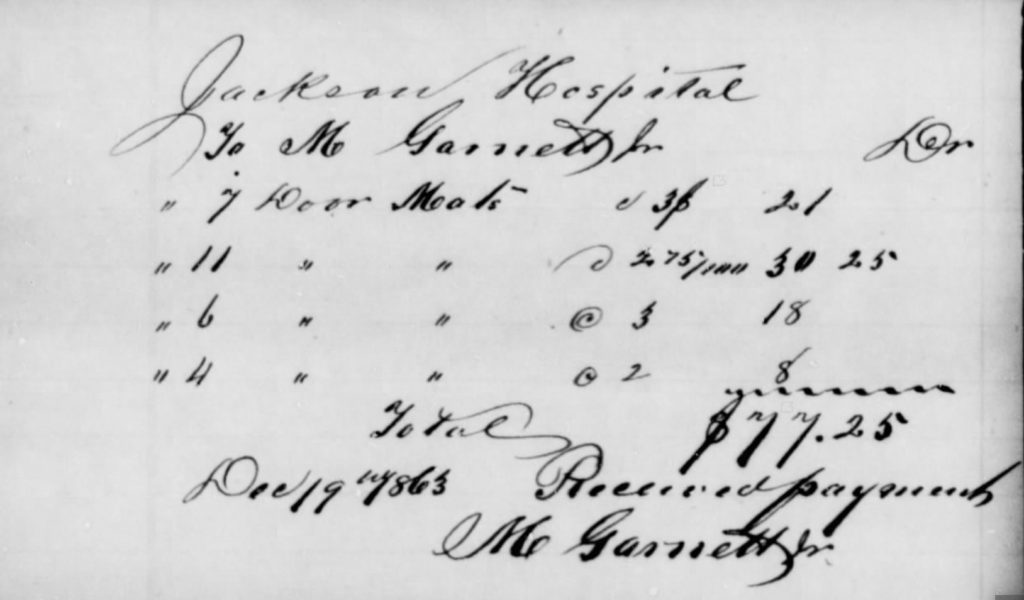
Dec. 19, 1863 Signed by Muscoe Garnett Jr.
He evidently earned his superiors’ trust and confidence because by February 1864 he was “acting as quartermaster,” and in September was appointed “Bonded Agent for the Subsistence… (and) Commissary Department.” By December he was listed as “Commissary of the Post”.
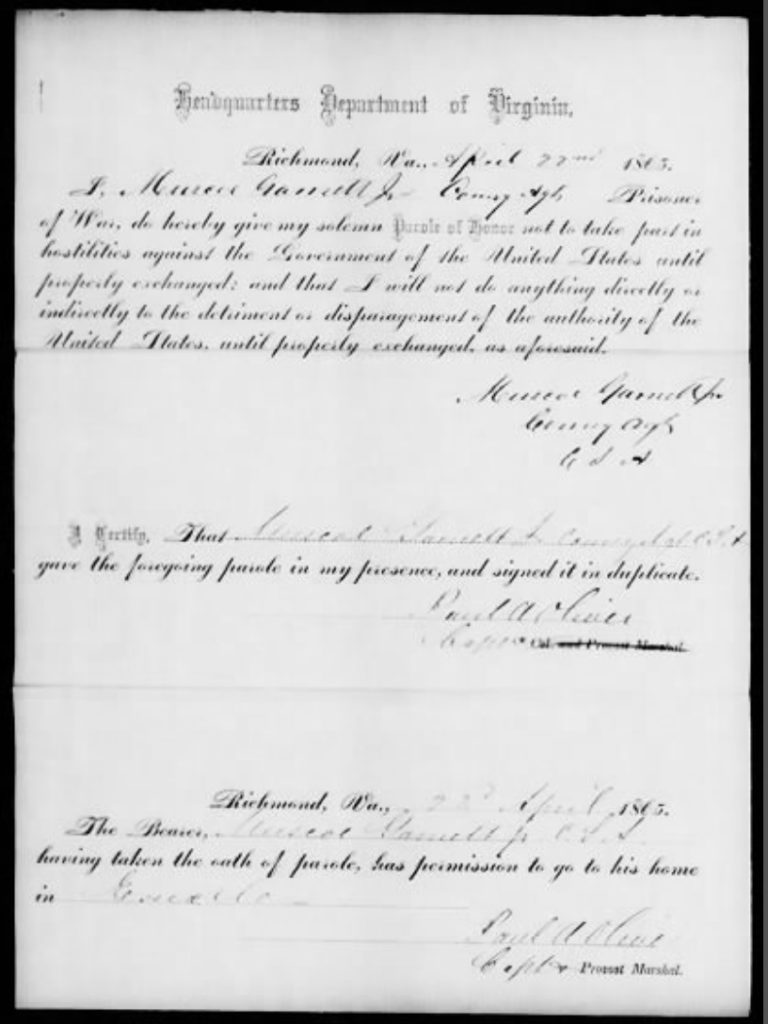
He remained in this position up until the end of the War. On April 22, 1865, he signed his parole and oath of allegiance to the United States. He returned to his home with nothing more than the clothes on his back and his horse, and lived out the remainder of his years in Essex county, before succumbing to complications from a hip fracture at age 90.
Below is the image of his final parole and oath of allegiance to the United States, ending his service in the Confederate Army: