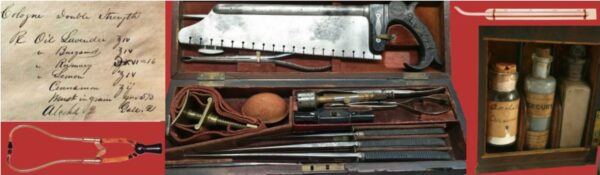
This is a rare set, with all original contents, complete save for a few minor instruments. It is a great item to contrast to the set belonging to Dr. Thomas Benjamin Noble shown above, which was made only a few years earlier by the same manufacturer. This set has a cartouche engraved “U.S.A. Medical Department.” It also contains a packet labeled “Field Tourniquet” which fits perfectly into its own spot in the case – leaving little doubt as to where the surgical set was intended to be used.
This particular set is virtually identical in both size, content and arrangement to another Snowden set (featured on Dr. Michael Echols superb site, medicalantiques.com) that he dates to the early-war years. However, it differs in one important (though I think explainable) feature: the one shown here has a single keyed lock (typical of civilian sets) instead of the double latches found on most military-issued sets. There is no reason to doubt the authenticity of the construction of this set, nor the authenticity of the Medical Department-marked cartouche (which is again, identical in shape, size and font to the one on the other Snowden set).
My theory is that just prior to the outbreak of the Civil War, when the Medical Department began clamoring for more sets, major suppliers (like Snowden) would have had in their inventory cases with the keyed locks. In their rush to fill orders, they could have filled a small number of these cases with the proper set of instruments, engraved the cartouche with “U.S. A. Medical Department”, and shipped it out.
If this were the case, this particular set would date to the very early wartime period, when Snowden was transitioning to production away from civilian cases with a keyed lock to military-issued cases with double latches. Interestingly, Dr. Echol’s website also features a larger capital operating set, also made by Snowden and Brothers in the early part of the War, which has BOTH the center keyhole as well as the double sliding latches! This substantiates my theory that early on, there was a “crossover” period between Snowden’s production of center-keyed (civilian) set cases and double-sliding latched (contract) cases.