WILLIAM OLAND BOURNE & THE PENMANSHIP CONTEST
What makes Pendergrast’s story unique, is that post-war, he became a “member” of a group of soldiers known as the “Left Arm Corps”. It all began with William Oland Bourne (1819-1901) who was a hospital chaplain during the Civil War. He collected the names of the soldiers he tended, and noticed that many soldiers used their left hand to write since their right arm was missing. In addition, he served as the editor of “The Soldier’s Friend”, a newspaper dedicated to veterans needs, and published late in the war and for several years after. He saw firsthand the terrible injuries suffered by Union soldiers and sailors. Men who had performed manual labor before the war might need to find a new line of work. He wondered how these grievously wounded men would adapt – to the amputation of their arms, to post-war life, to new jobs. Bourne had an idea: a left-handed penmanship contest for previously right-handed veterans who lost their right arms in combat – a small way to demonstrate self-reliance, adaptability and the skills necessary to find post-war employment.
“Penmanship is key to getting a government position”, a contest ad read in “The Soldier’s Friend.”
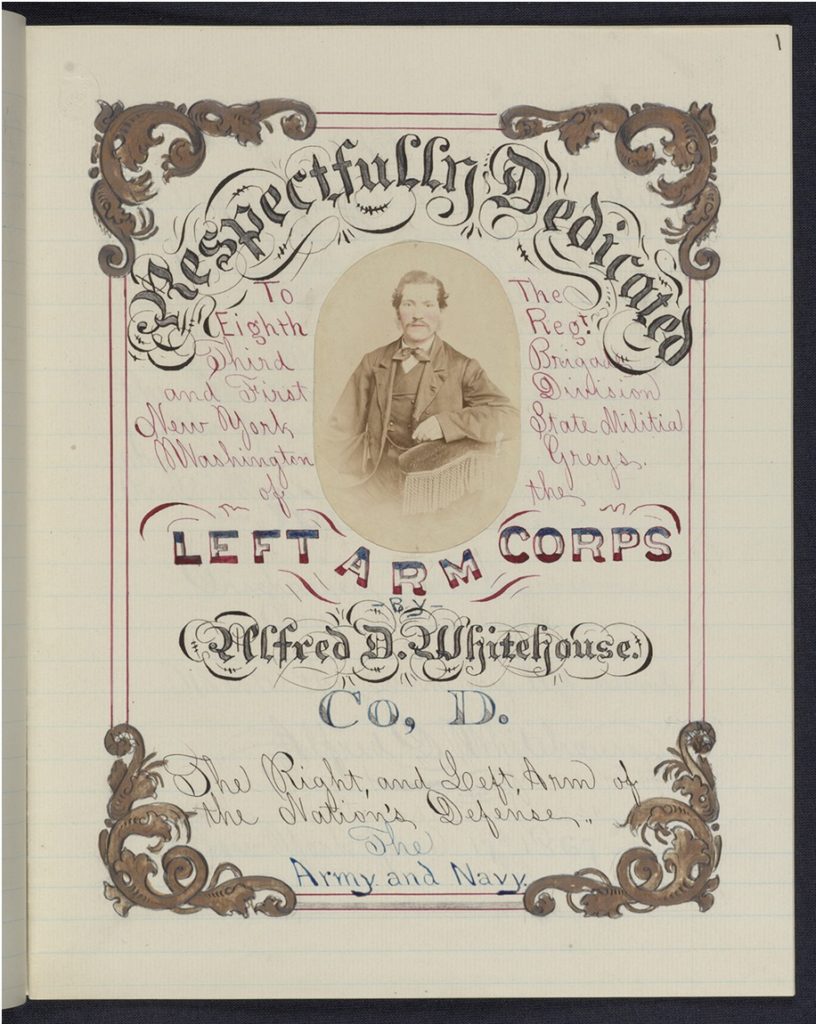
The contests offered cash prizes and emphasized the quality of penmanship. This first contest, held in February 1866, awarded a total of $1,000 in prizes for the winning entries. Some veterans filled their entries with poetry, some simply copied text to demonstrate their penmanship. Most however, like Pendergrast, told their own stories. In some entries, the penmanship is remarkably neat, the letters well-formed, and the presentation even artistic, like that of Alfred D. Whitehouse, who produced the elaborately illustrated page shown below- bearing his photograph and dedicated t0 the “Left Arm Corps”:
The contests attracted hundreds of entrants – not of all of whom precisely fit the criteria.
Lewis Horton lost both of his arms in a naval accident. Undeterred, he entered a letter – certified by a justice of the peace – that he claimed he wrote using his teeth.
Jesse Pendergrast was another exception to the criteria. Although he was not a double amputee, he had lost his right arm- and two fingers and part of the thumb on his left hand. His photograph was sent along with his entry, and is shown on the first page of this display.
As you will see, he was awarded a special prize for a letter produced under “exceptional circumstances.
The first contest closed with an exhibition of nearly 300 entries at a New York hall festooned with inspirational banners: “Disabled but not disheartened,” ” Our disabled soldiers kept the Union from becoming disabled.” The display drew big crowds and many dignitaries, including Lt. Gen. Ulysses S. Grant and Major Oliver O. Howard, who himself lost his right arm at the Battle of Seven Pines in 1862.
The first contest was such a hit that Bourne decided to stage a second competition in 1867, in which a total of $500 was awarded in cash prizes. For that contest, Bourne enlisted major Civil War figures: Grant, Adm. David Farragut, and Gens. William T. Sherman, Philip Sheridan, and George G. Meade – to each choose a prizewinner and write a letter to him.
In 1931, a prominent New York bookseller named Gabriel Wells donated Bourne’s huge archive of papers to the Library of Congress. Almost a century later, Michelle Krowl, a historian in the Manuscripts Division, noted that those letters do something more – Bourne’s contest unintentionally preserved stories that otherwise might never have been told – she said:
“This might be the only place their recollections are captured. Unless they filed for a pension and gave their life stories as their claims, this might be the only place they told their life stories or expressed what they felt about losing their arms.”
Jesse Pendergrast’s entry was a story of his wartime experiences, including the terrible incident that cost him his right arm and half the fingers on his left hand. It was one of the many recorded in Bourne’s papers and now digitized. This display is dedicated to preserving his memory and his contribution -physically and emotionally- to the war that changed the course of our nation.
(Note: Much of the text and photos in this display was taken (some nearly verbatim) from the article written by Mark Hartsell on June 27, 2016, and found on the webpage https://blogs.loc.gov/loc/2016/06/new-online-william-oland-bourne-papers/.)