MARVIN LINCOLN, INVENTOR OF THE LINCOLN ARTIFICIAL ARM
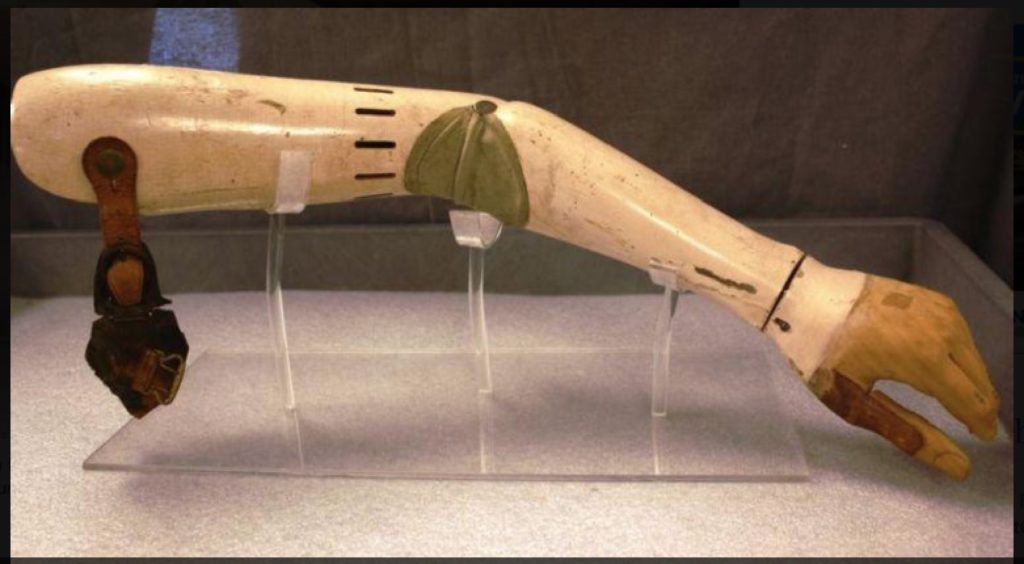
The arm was made of maple wood, and features a lockable elbow joint, an opposable control thumb,
a replacement hand, and ventilation holes for the elbow stump.
(Photo and text from The National Museum of Civil War Medicine website)
In the years leading up to the Civil War, Connecticut native Marvin Lincoln (1814 – 1909), was an agent in the underground railroad, and a prominent abolitionist (and former associate of John Brown). He also held one-third interest in a manufacturing business owned by Benjamin Franklin Palmer, the the foremost supplier of artificial limbs throughout New England and New York.
The Civil War left many veterans missing arms, legs, hands, etc., leading to a large (and lucrative) market in the artificial limb business. Then, as now, prosthetic limbs were useful tools that enabled veteran amputees to rejoin the workforce, engage in leisure activities, and continue to fulfill their social obligations. The artificial arm was considered a “worthy” substitute for nature.
Later on, after selling his share of interest, Lincoln took over the Boston branch of the Palmer’s business, then moved to New York City and opened his own establishment. He was one of the early makers approved to supply artificial arms for the Union limbs program. Both Palmer and Lincoln furnished artificial limbs from the same office during the war, though the army soon adopted the “Lincoln Arm” as their preferred choice for disabled veterans. It would remain in use into the First World War.
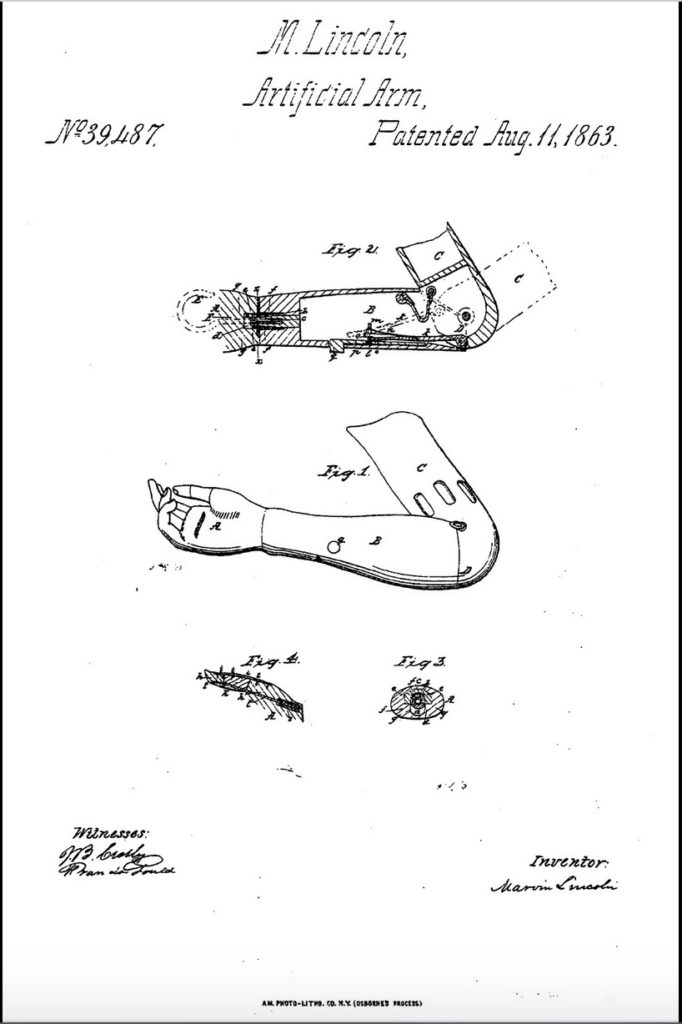
In 1863, Lincoln designed and obtained a patent for what he would ultimately market as “Lincoln’s Artificial Arm”:
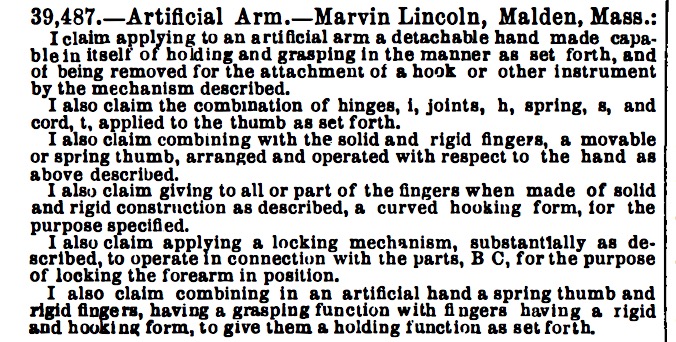
That same year, a notice of the new patent appeared in the journal “Scientific American”:
In 1865, Lincoln published a twenty page pamphlet advertising his “Patent Artificial Arm” as “practically available in the ‘rough and tumble’ of every-day life” while at the same time “artistic and beautiful in its shapes and appearances. It was a device that concealed the loss of a limb and gave the wearer a “consciousness” of himself as a whole man, and was “entirely worthy to fill the ‘vacant’ sleeve.”
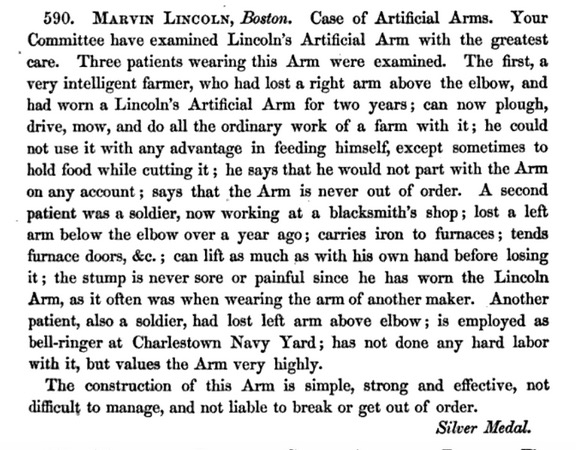
In September of 1865, he entered his invention in the “Tenth Exhibition of the Charitable Mechanic Association”, held in Boston, and was awarded the Silver Medal:
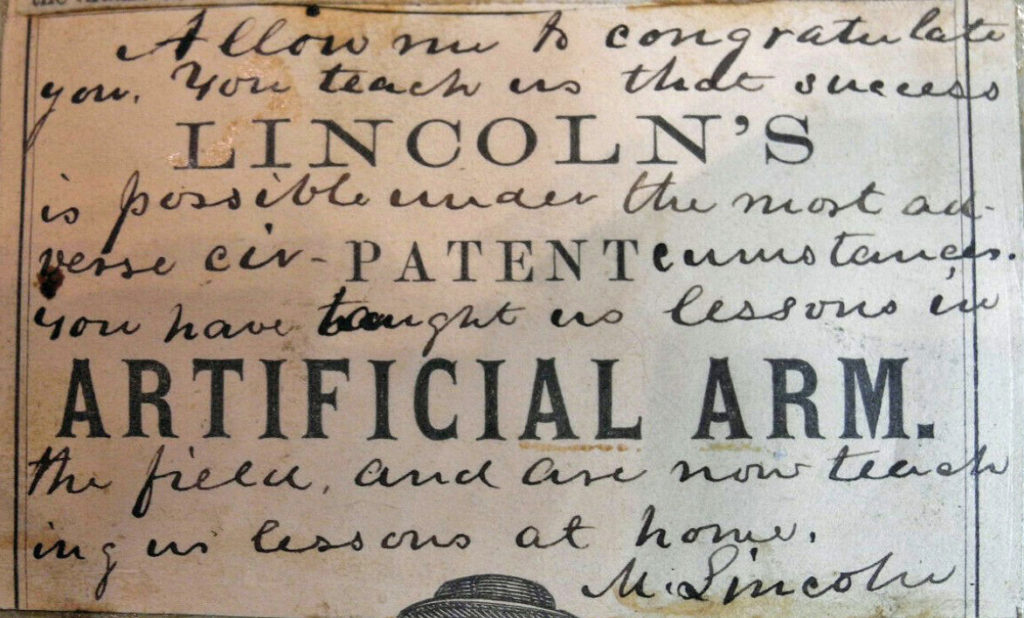
In 1866, the Surgeon-General’s office issued a report with the names of the Union soldiers and sailors who received a prosthesis, its cost, and the manufacturer (one of Lincoln’s arms cost the Army $50.00) . Jesse Pendergrast’s name is not on that roster. It is possible that as a result of his winning entry into William Oland Bourne’s penmanship contest (see below), he was approached by Lincoln – perhaps even offering his invention as a gift. Whatever the reason, Lincoln sent a copy of his newspaper ad to Pendergrast, upon which he wrote:
“Allow me to congratulate you. You teach us that success is possible under the most adverse of circumstances.
You have taught us lessons in the field, and are now teaching us lessons at home.”
Marvin Lincoln died in 1909, having witnessed how his invention change hundreds of disabled soldiers’ lives for the better. He lived with his daughter in Washington D.C., where he died at the age of 95, and is buried in Connecticut.