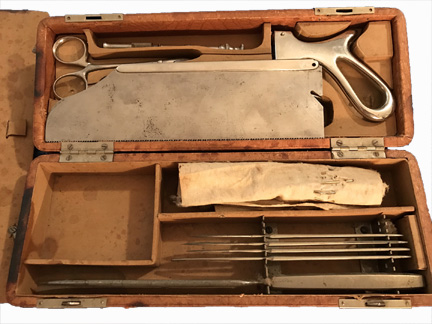
This amputation set clearly illustrates the multitude of changes that occurred during the era of mass production and post-sterilization. The case is covered with a thin veneer of embossed leather, the velvet lining has been replaced by thin leather and paper. The keyed latch of the civilian set, and dual sliding latches of the military contract sets, have been replaced with a pair of generic-looking chromed spring latches.
The instruments are now completely made of non-porous material, the handles with smooth surfaces to avoid any caking of blood or surgical debris. Scissors and clamps are now multi-racheted, and are capable of disassembly for easy sterilization.
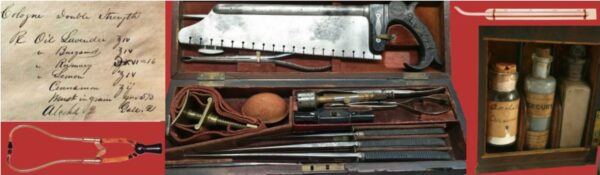
The bespoke, plush, velvet-lined mahogany amputation sets, filled with rows of handcrafted tools with ivory and ebony handles, were no longer being made. Aging American surgeons, ones who habitually bled their patients for fever, whose memories of the Civil War were an unending stream of mangled bodies, amputations, and gangrene – those who wiped their knives on bloody aprons – they were being replaced by younger physicians who religiously dipped their hands and beards in carbolic acid prior to operating. This new breed of surgeon had been taught the germ theory of disease, and demanded affordable, mass-produced, all-metal sets with instruments whose materials and simplicity of design facilitated sterilization.
A sea change had occurred, over a span of only 25 years.