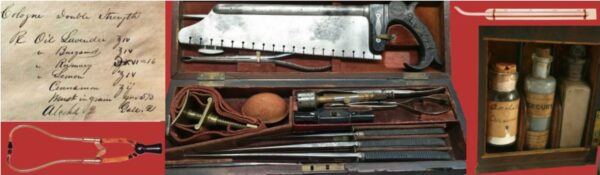
OWNED BY A CALIFORNIA PHYSICIAN
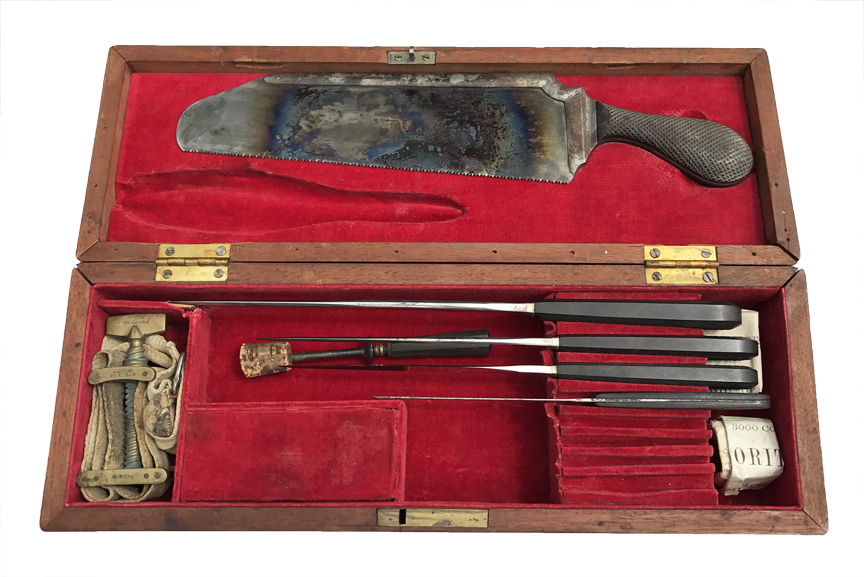
This set came from a physician who had located to Northern California in the nineteenth century, and was passed through three generations of physicians. Unfortunately, the name of the original owner and family has been lost to history.
It is missing some instruments, including the bone forceps, but three knives, the tourniquet and amputation saw are all marked “Otto and Koehler, New York”. There is an unmarked trocar, a thumb lancet (marked “Evans Old Change”) with partial case, and a folding tenaculum of the sort found in pocket surgical sets, marked “Tiemann & Co.” in Old English font. While it lacks a full complement of instruments, it is a very rare set – I scoured the internet and was unable to find any surgical set by this maker – only one or two individual instruments, and one set of obstetrical instruments in a leather roll-up.
THE PAPERS FOUND IN THE SET
There were two papers found in the set, a torn cover from the “Attorney General’s Opinion and Message from the Governor on State Prison Affairs” , which was printed in 1858 by “John O’Meara, State Printer”, who was elected the state printer for California for 1858 – 1859. The other paper is an advertisement for an 1881 book by B.W. Palmer, “Favorite Prescriptions of Distinguished Practitioners”. Photos of these can be seen in the link below:
Research has uncovered that Dr. William A. Grover was the resident physician at Folsom State Prison, which opened in 1880. In the 1880’s, Dr. Luther Harvey Cary, a Civil War veteran, was the resident physician for San Quentin State Prison, located across the bay from San Francisco. Did one of these physicians own the set? No one knows for certain.
THE FIRM OF OTTO AND KOEHLER
This amputation set is a rare example by a small manufacturing firm that had its roots with George Tiemann. Tiemann, who had begun business in lower Manhattan as a cutler, transitioned to surgical instrument manufacturing by 1841. Over the ensuing decade, George Tiemann’s business was a well-established enterprise, and he was considered the pre-eminent surgical instrument manufacturer in New York City. Tiemann trained a number of young men who then started their own businesses. Most, if not all, began in New York and catered to the same clients that patronized Tiemann.
The first two defections from Tiemann occurred in 1850, when Konstantin Klott and Franz Wolf left to open separate shops in Ohio. The third defection occurred in 1854, when two young Tiemann employees, Ferdinand G. Otto and August Koehler, opened a shop at 58 Chatham Street. Their partnership lasted until 1860, when Koehler withdrew, and Otto took on John Reynders, another German-born former employee of Tiemann. Otto and Reynders remained in business at 58 Chatham Street until 1864, when they moved to 64 Chatham Street. Their partnership ended in 1875, and the split gave rise to F. G. Otto and Sons, and John Reynders & Co., two important New York firms in the latter quarter of the nineteenth century.