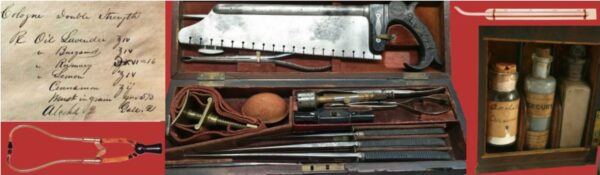
OWNED BY DR. CHARLES SNOWDEN PANCOAST
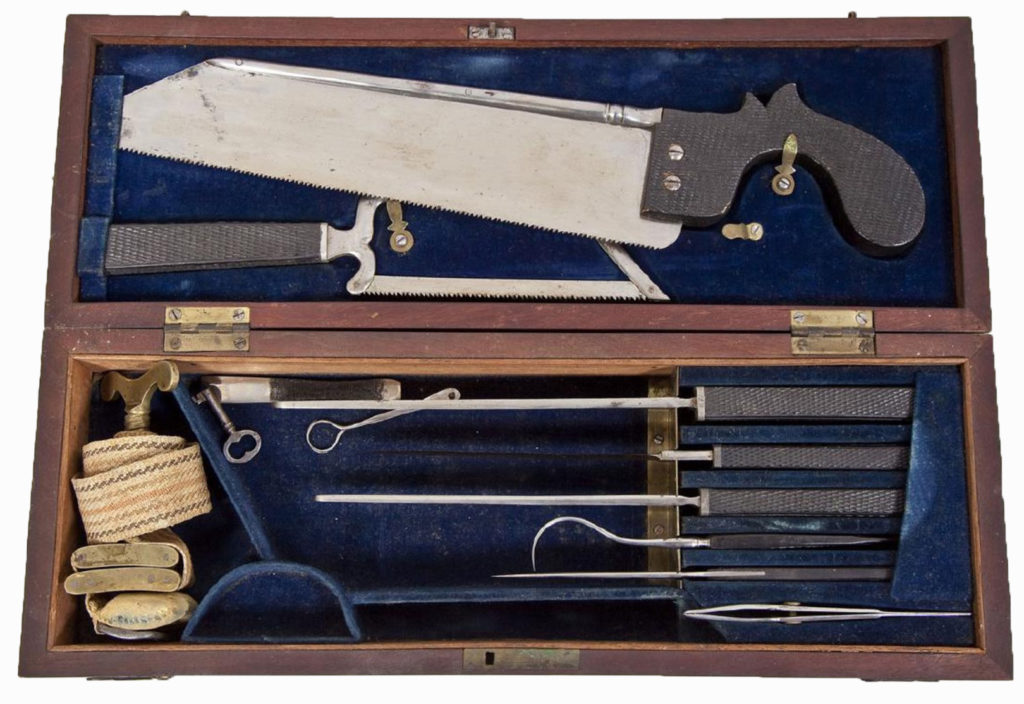
This set is nearly complete, missing only the bone forceps, with many of the original instruments present- even the key is still present. The knives date the set the to c. 1845 time period – they have wide spines and wide, slightly downturned blades. The only instruments marked “Wiegand & Snowden” are the two Lister knives, and the single catlin. The tenaculum and locking artery forceps are unmarked, but fit perfectly into place. The capital saw and metacarpal saw are unmarked, but fit perfectly into position and are exactly like those found in other Wiegand & Snowden sets of this time frame. The scalpel is marked “Helmold” (active 1851 – 1897) and the tourniquet is marked “Schively Philadelphia” (active 1785 – 1855), and has the striped cloth strap typical of the Civil War era. The bleeder is marked “Wiegand & Snowden”.
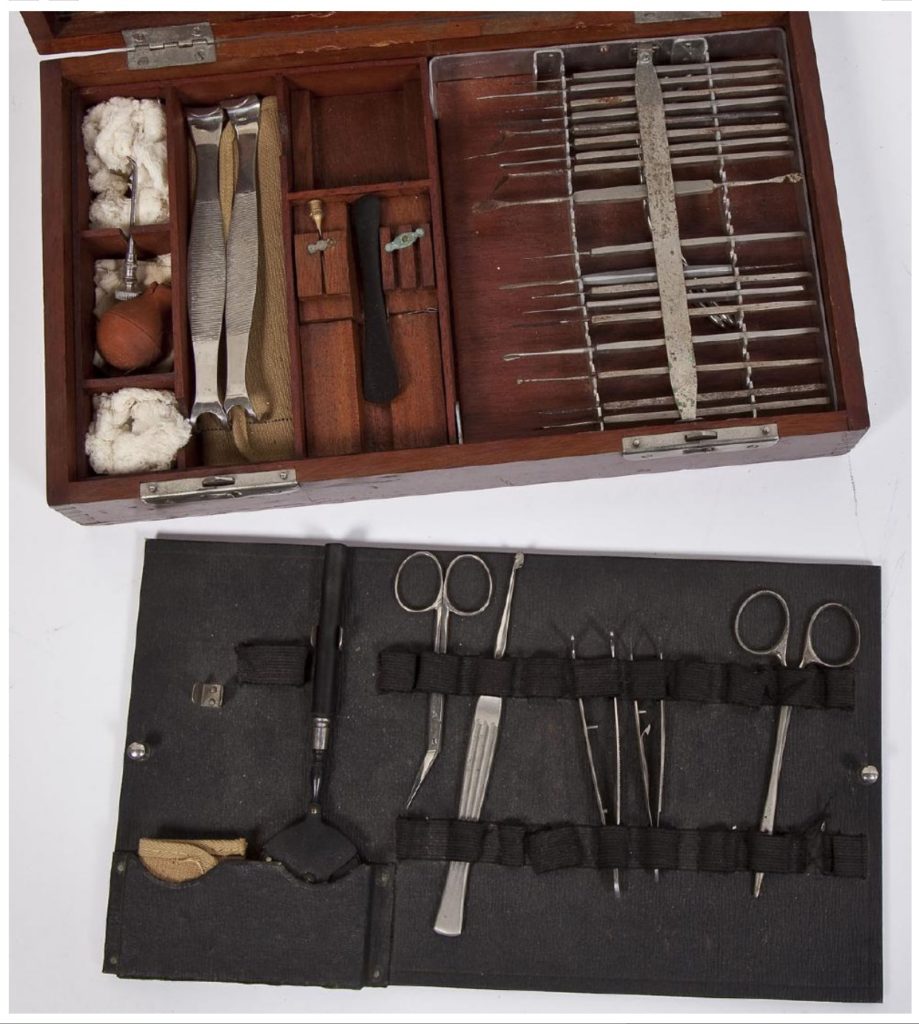
This set was part of a sale that included other, late-20th century surgical sets, instruments and medical books which were used by Dr. Charles S. Pancoast, and which are shown below:
MY THEORY ABOUT THIS SET AND DR. PANCOAST
Charles was born in 1883, and graduated from medical school in 1910 – so by the time he began practice, the era when physicians used non-sterilizable instruments had long passed. For this reason, I believe this set was owned, but not used by him. After researching the family, I believe there is a good chance that the set was originally used by the only other physician in the family, Charles’ great-uncle Dr. Richard Montgomery Pancoast. A brother to Charles’ grandfather James Ellwood Pancoast, Richard M. was born in 1826, and graduated from Jefferson Medical College in 1845. He practiced for over 50 years in Philadelphia, and never married, dying at age 85 in March 1910. Later that same year, Charles graduated from medical school. It is strictly hypothetical, but the timing of these two events could certainly indicate that Richard passed on this set to Charles as a graduation gift.
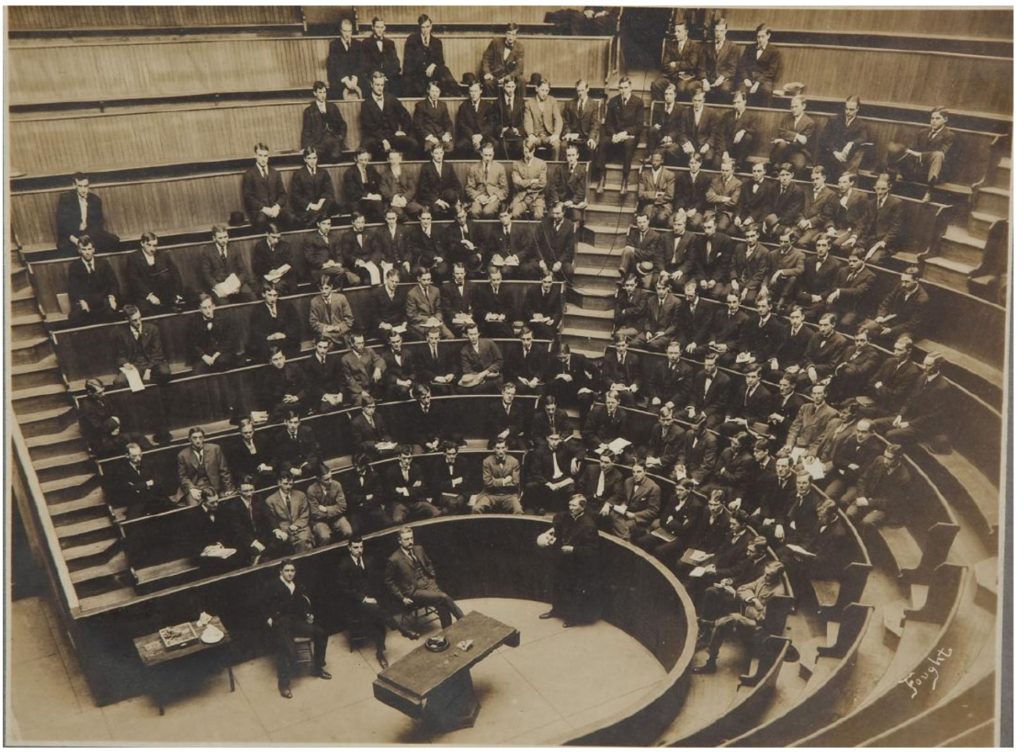
including Charles S. Pancoast
Students are assembled for Dr. Geo. McClellan’s class on Applied Anatomy.
Photo taken November 4, 1907 by Dr. E. N. Fought, Official Photographer of JMC.
CHARLES SNOWDEN PANCOAST, M.D. ( 1883 – 1964)
Charles was born in New Jersey, the eldest of five children born to Robert Montgomery Pancoast, Sr. and Laura Tomb Stockham, who were Quakers. Robert Sr. was a well-to-do Philadelphia commission merchant and erstwhile inventor, who secured a patent for a combination yo-yo and spinning top. The family lived across the river in Camden and then Mullica Hill, New Jersey.
He graduated in 1910 from the Medico-Chirurgical College of Philadelphia, was resident physician at Pottstown Hospital, and worked at Polyclinic and Wills Eye Hospital In Philadelphia.
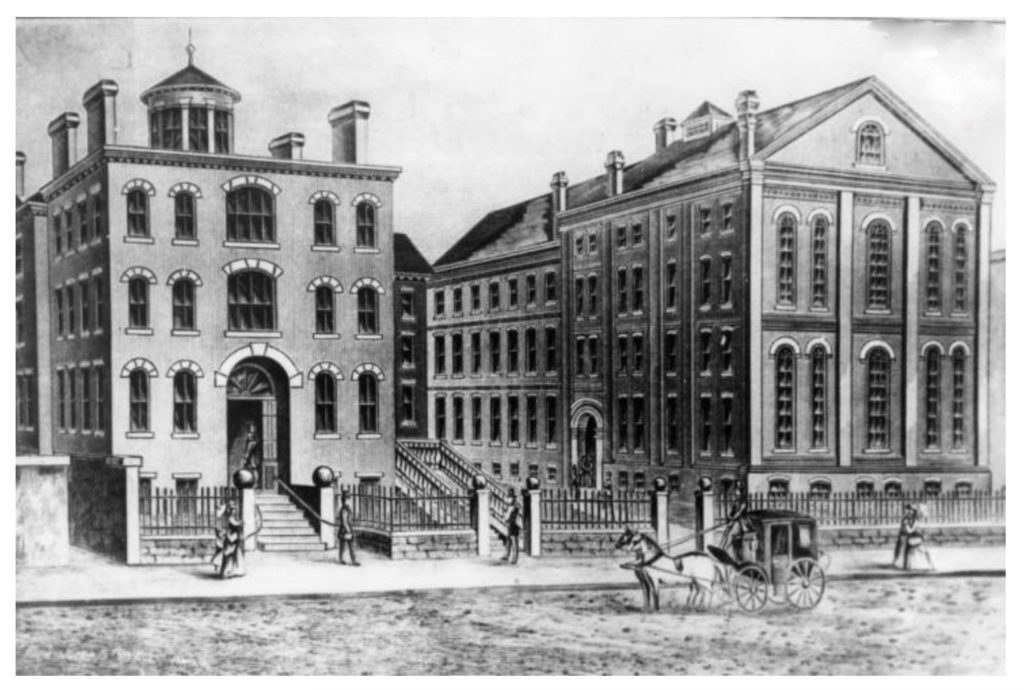
The college later merged with the University of Pennsylvania Medical School.
Charles also served as surgeon to the Third Regiment National Guard of Pennsylvania. Shortly after opening up practices both on Chestnut Street in Philadelphia and at his parent’s home in Camden, he accepted a call to the Vienna Hospital Service and sailed to Austria in December 1914, becoming the first Camden physician to serve on the battlefields in Europe during World War 1. In July of 1915, he was a staff surgeon under General Gyula Dollinger, chief surgeon of the Hungarian Army, in the Royal Hungarian Hospital, Budapest. Within the year, he was placed in charge of a 4,000 bed hospital in Munckacz in the Carpathian mountains. In March 1916, he was placed in charge of the surgical department of a large war hospital in Sofia, by the Bulgarian War Department. Reportedly, he was considered to be a spy, and ill-treated during his time in Bulgaria. He returned home that May, but in August 1917, left to return overseas, this time to take charge of Field Hospital No. 3 on the French front. He returned to America after a few months and was married in November 1917 to Minnie Loretta Percell. They had two daughters, Charlotte Snowden Pancoast and Loretta Snowden Pancoast. Sadly, Charles was widowed in 1926 when Minnie died at Norristown State Hospital from the long term effects of Huntingtons’s Chorea, a degenerative neurological condition. After her death, Charles’ 4 siblings, all of whom were unmarried – his brothers Richard Montgomery Pancoast, Jr. and James Pancoast, and sisters Laura and Mary Pancoast – resided with him at his home on Greene Street in Philadelphia. Charles never remarried, and died in an old-age home in 1964 at age 81 from heart failure.
JOSEPH PANCOAST, M.D. and WILLIAM HENRY PANCOAST, M.D
Charles bore the names “Snowden”, and “Pancoast” – each of which is a noted name in the medical field in Philadelphia. Charles was in fact a distant cousin of two Philadelphia surgeons also named Pancoast: Joseph Pancoast, M.D. and his son, William Henry Pancoast, M.D.
Dr. Joseph Pancoast graduated from the University of Pennsylvania Medical College in 1828. In 1838 he was elected professor of surgery in Jefferson Medical College, and in 1847 was transferred to the Chair of Anatomy, which he filled till 1874, when he was succeeded by his son, William Henry Pancoast.
From 1854 till 1864 he was one of the surgeons to the Pennsylvania Hospital. Dr. Pancoast was the originator of an operation for soft cataract with a fine needle, bent near the point. He devised many new operations in plastic surgery, among them the formation of a nose by means of the plough and groove or plastic suture, introduced in 1841; a substitute for the eyebrow, formed from a flap of the scalp; the introduction of a catheter for empyema into the pleura by raising a flap of the integuments over the ribs; turning down flaps from the skin of the abdomen for the relief of exstrophy of the bladder, which was first performed by him in 1868 ; and the raising of a flap over the coronoid process, and the removal of that process and part of the lower jaw in order to divide the trunks of the nerves that cause pain in facial neuralgia. He discovered that in some cases of strabismus the internal oblique muscle must be cut. He has restored the voice by dividing the muscles of the soft palate that have become contracted from ulceration. He also devised an abdominal tourniquet, which he first used in 1860, for compressing the aorta, and thus preventing” death from loss of blood in amputation at the hip-joint or upper thigh.
His son, William Henry Pancoast, graduated at the Jefferson Medical College in 1856, studied for three years in London, Paris, and Vienna, and on his return established himself in practice in Philadelphia, and acquired a high reputation as a bold, rapid, and skillful operative surgeon, conservative in treatment and seldom mistaken in diagnosis. He served in the Union Army in the Civil War as an Assistant Surgeon.