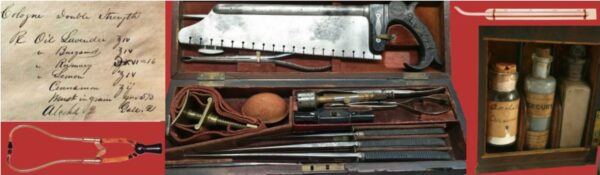
RARE SET OF AMPUTATION KNIVES MADE BY WILLIAM PINTARD, c. 1820-25
Edmonson calls Philadelphia “the first home of the instrument trade in the United States”. In the mid-18th century, Philadelphia was the center of medical education and training – as Edmonson calls it, “the medical Mecca of the country until the Civil War.” He lists five individuals who identified themselves as instrument makers early in this era, each in business for only one or two years – hence their names are “encounter(ed) only fleetingly.” One of these was William Pintard (1798 – 1801). The businesses of these fledgling manufacturers were soon usurped by makers like John Rorer and Henry Schively, who flourished during this time and whose commercial success continued into the decades immediately preceding the Civil War.
New York followed slightly behind Philadelphia. According to Edmonson, William Fosbrook was the first to appear in the city directory as a “surgeon’s instrument maker” in 1786. His business was rivaled by only a handful of other makers in the city at this time: James Anderson, George B. Smith, and a team of British ex-patriates, John Bailey and James Youle. Smith lasted until 1805, and Fosbrook and Anderson retired in 1819. After 1820, a new generation of cutlers specializing in surgical instruments appeared on the scene, most of whom had emigrated from Britain.
What Edmonson does not mention, and what is provable (see his advertisement below) is that in 1820, William Pintard left Philadelphia and moved to New York, taking over William Fosbrook’s business at No. 3 Beekman Street. He continued as a surgical instrument maker until 1850. This is possibly the same William Pintard who lived from 1777 – 1852 (and died in Monmouth county, New Jersey).
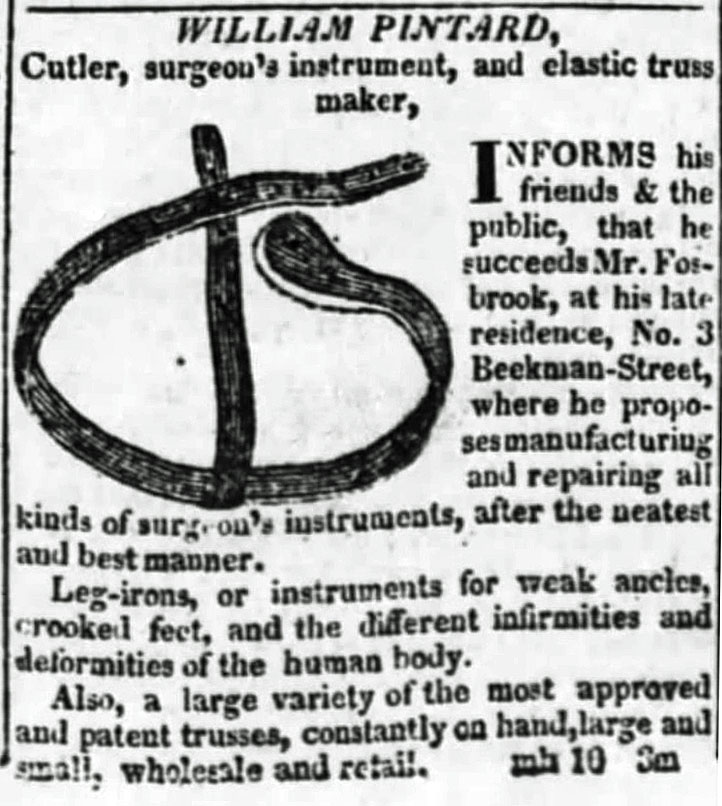
New York Evening Post
17 March 1820
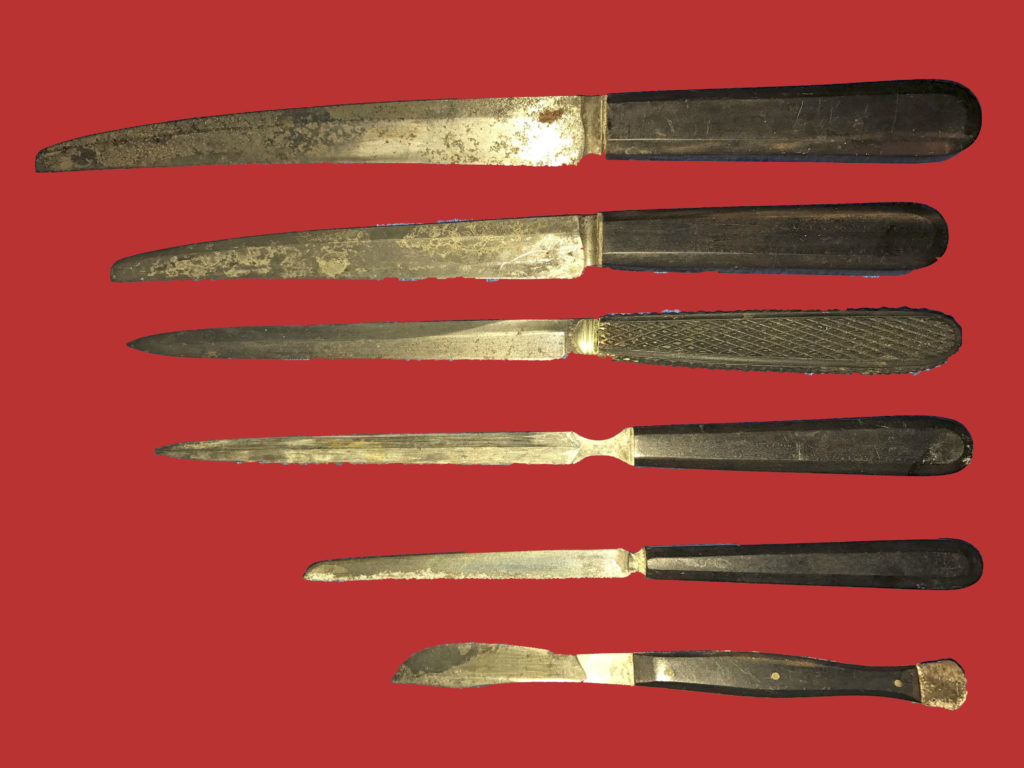
This set is quite rare, as there are but few extant examples of Pintard’s work. The Warren Anatomical Museum at Harvard has a set of ivory-handled instruments, knives and an amputation saw with slotted blade (thus post-1831, since this design was developed by John Weiss of London in 1831.) In the set presented here, which is believed to pre-date the Harvard set, five of the six knives have matching construction and ferrules, and three have a still-legible stamp of “Pintard New York”. The saw is unmarked but is quite possibly c. 1820-25 and made by Pintard. There is one instrument, a catlin, that is not made by Pintard; the maker’s stamp is partially obliterated by oxidation and wear – however it is possible that it is by “Goulding & Co.”