WITH TAG WRITTEN IN HIS OWN HAND, DOCUMENTING THE WOUND HE SUSTAINED AT THE BATTLE OF OPEQUON CREEK ON SEPTEMBER 19, 1864. AND PAGES FROM HIS DIARY
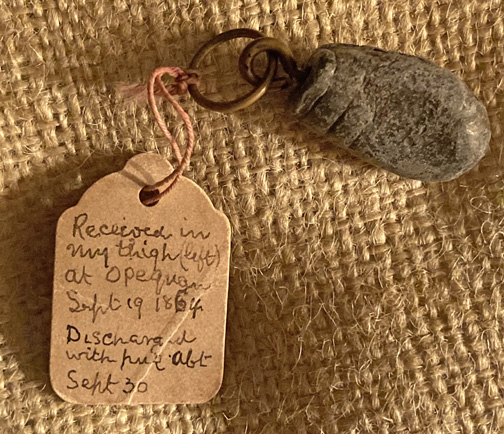
“Received in my thigh (left) at Opequon Sept 19 1864 Discharged with pus abt Sept 30′“
Capt. William Henry Whitney, Company G, 38th Massachusetts Infantry was wounded in the left thigh with this .58 caliber Springfield Minie ball on September 19, 1864. at the battle of Opequon Creek (also known as the Third Battle of Winchester.) That same day he sustained a second bullet wound to his right foot. This grisly relic is accompanied by two original pages from his 1864 diary from April 12 – 14, describing embarkation on a steamer and guerrilla attack while en route to reinforce the 19th Corps at Grand Ecore, as well as a color copy of the diary pages describing his regiment’s part at Opequon Creek, his wounds and subsequent treatment by the regimental surgeon.
CAPT. WILLIAM HENRY WHITNEY
1843 – 1909
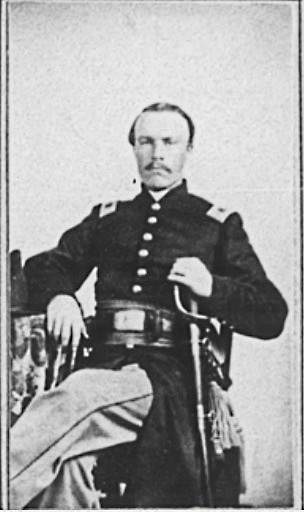
A resident of Cambridge, Massachusetts, Whitney was one of three children born to Charles Whitney, a blacksmith, and Caroline Stimson. His father died in 1850 and his mother remarried Nathan Russell, a shoe dealer, after which two step-children were added to the family. Whitney took a course at the Lawrence Scientific School at Harvard, then studied and worked as a civil engineer at a firm in Boston before leaving to enlist in the Civil War.
He was 19 years old when he mustered in as a private in Company A of the 38th Massachusetts Infantry on July 23, 1862, and was immediately made first sergeant. He was promoted through the ranks to 2nd Lieutenant of Co. E on March 4, 1863, and to Captain of Co. G on August 8, 1864. At the Battle of Opequon Creek he was wounded twice by bullets (once in the right foot and once in the left thigh). Discharged due to his injuries on December 20, 1864, he was brevetted Major in 1868, to date from March 13, 1865.
The University of Virginia Library contains 5 letters spanning August to September 1864 written to his mother, Mrs. C. F. Whitney Russell and his brother Frank E. Whitney, both of Cambridgeport, Massachusetts, concerning camp life and skirmishes near Berryville, Virginia during Philip Sheridan’s campaign in 1864. Additional letters from Whitney to his family are held at the Louisiana State University Library Archives at Baton Rouge, Louisiana, and were published in the book “Where Duty Shall Call: the Baton Rouge Civil War Letters of William H. Whitney” by Tara Zachary Laver.
THE 38th MASSACHUSETTS INFANTRY REGIMENT
Organized as a three-year regiment in August, 1862, the regiment was first assigned to the 19th Corps, Department of the Gulf, under Maj.-Gen. Nathaniel Banks and was stationed in Louisiana. It first saw combat in April 1863 at the battle of Fort Bisland. During May and June 1863, it was active in twin siege operations against the Confederate bastion at Port Hudson (in a letter dated June 1864 to his mother, Whitney notes that he was suffering from dysentery while at Port Hudson one year earlier.) The regiment was involved in the disastrous Red River Expedition of March 1864, but was only lightly engaged.
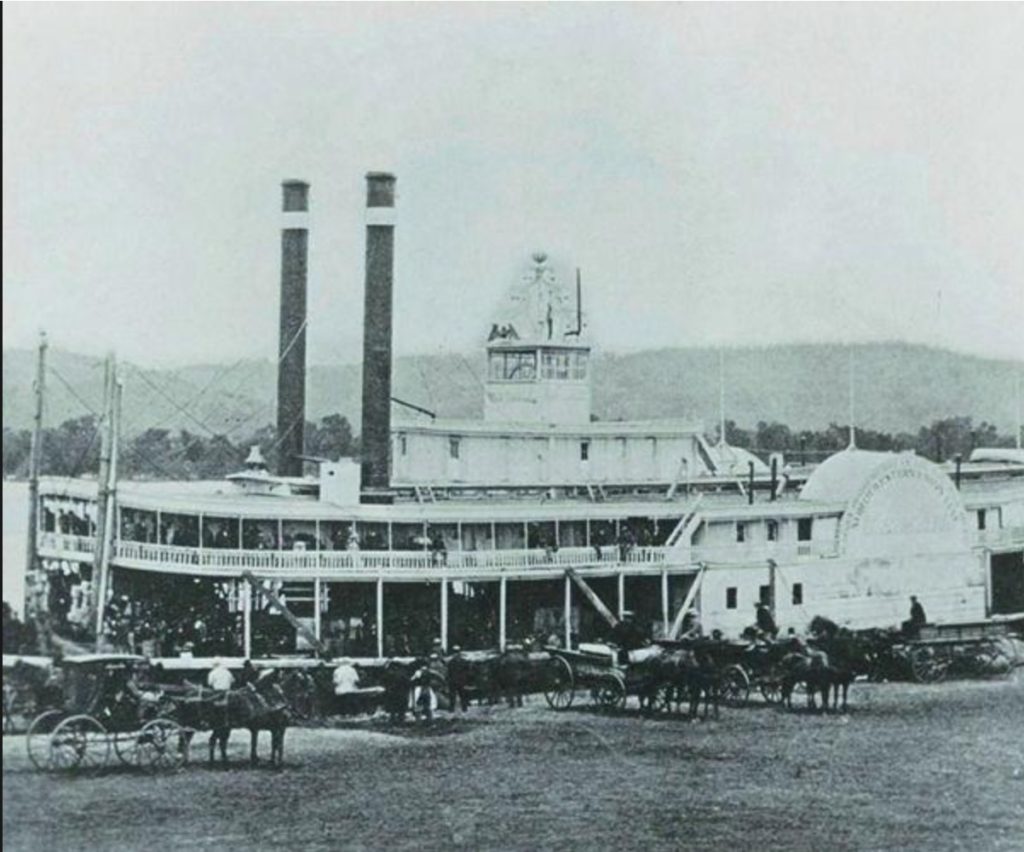
In April 1864, the Third Brigade, of which the 38th Massachusetts was a part, was selected to garrison the city of Alexandria, located on the banks of the Red River, while the other brigades marched to Shreveport. Initial reports indicated Shreveport was safely in Federal hands, but the Confederates rallied and General Banks needed reinforcements. On April 12, the 38th left Alexandria and steamed up the river aboard the “Mittie Stephens” to join the 19th Corps, encamped at Grand Ecore. They were attacked by guerrilla forces en route, which Whitney details in the original diary pages shown below (with transcription.)
In July 1864, the 19th Corps was sent back east and reassigned to the Army of the Shenandoah, commanded by Maj.-Gen. Philip Sheridan. The 38th Massachusetts was engaged in several battles of the Valley Campaigns of 1864, most notably the battle of Opequon Creek on September 19, 1864, followed by Fisher’s Hill on September 22 (where they were lightly engaged), and the battle of Cedar Creek on October 19, where they again suffered significant casualties.
In January 1865, the brigade was transferred to the Dept. of North Carolina where it went into camp at Morehead City. Here, the brigade guarded the massive supply depot that supported Sherman’s operations in the Carolina’s. After two months of guard and occupation duty at Savannah the regiment was finally mustered out on June 30, 1865, having lost 4 officers and 73 enlisted men.
ORIGINAL PAGES FROM WHITNEY’S 1864 DIARY
WITH ENTRIES MADE APRIL 12 – 14, 1864
DETAILING A GUERRILLA ATTACK EN ROUTE TO GRAND ECORE
The original diary pages cover entries made from April 12 -14, 1864. George W. Powers, author of the book “The Story of the Thirty Eighth Regiment of Massachusetts Volunteers” describes the attack by rebel guerrillas as the regiment steamed upriver:
…before a minute had elapsed , a shower of bullets poured into the boat, rattling against the smoke-pipe, smashing the cabin-windows, and whistling by the heads of the astonished men. Taken completely by surprise, away from their guns and equipments, and no enemy in sight, for a few moments there was some confusion; but the men soon rallied, and poured several volleys into the woods, although, as the boat kept on her course, the fire was probably ineffectual.
Considering that the regiment was fully exposed, and the enemy perfectly secure in his hiding-place, the casualties were remarkably few…
The “Mittie Stephens” continued on, and joined the 19th Corps which was encamped at Grand Ecore.
The original diary pages are shown below, followed by a transcription:
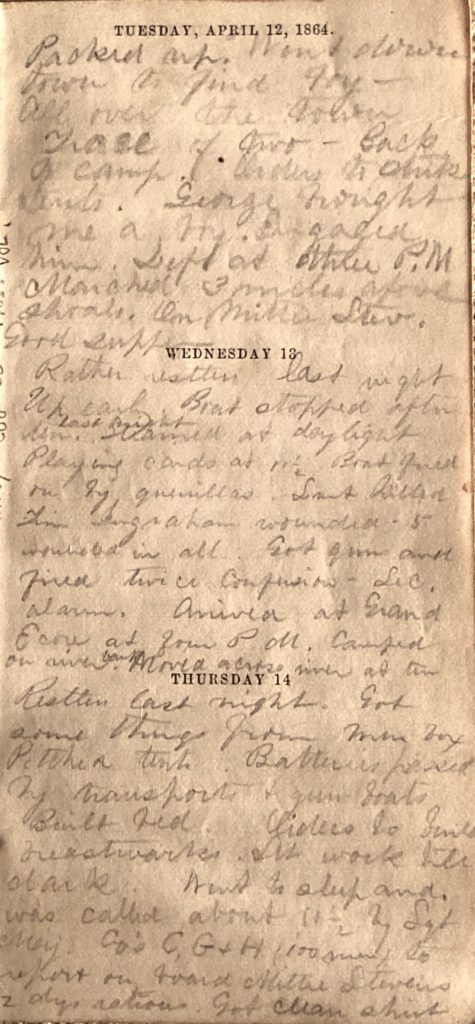
Diary page entries from April 12 – 14, 1864
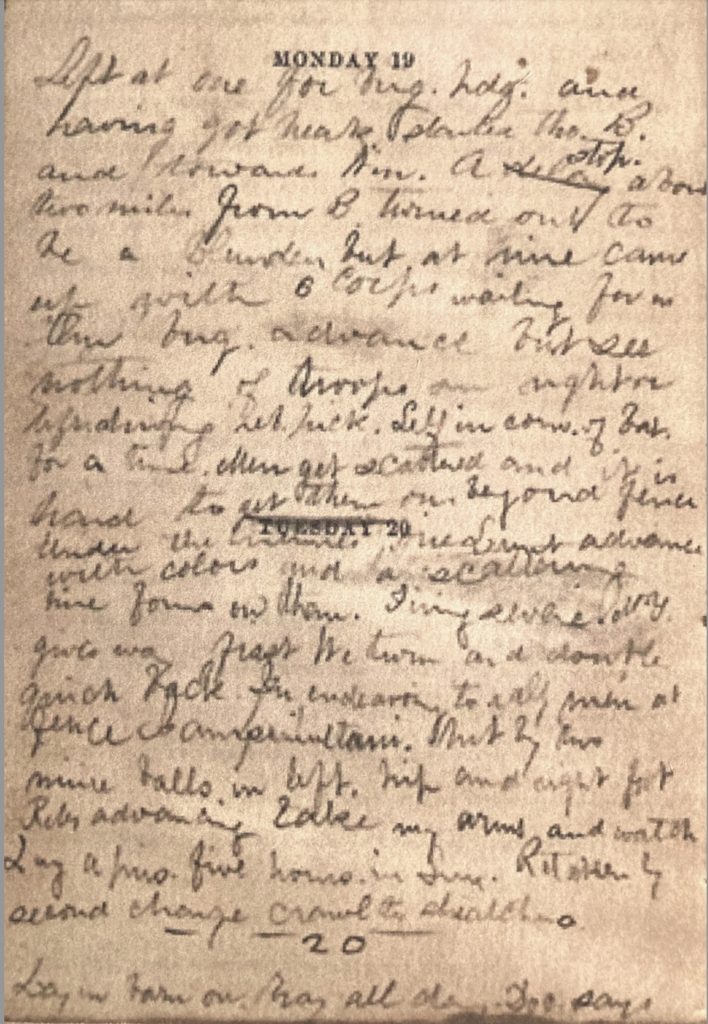
Closeup of entires on made April 13 – 14, 1864
Transcription of above pages:
Tuesday, April 12, 1864:
Packed up. Went down town to find Fry. All over the town. Trace of two. Back to camp. Order to strike tents. George brought me a box. Engaged him. Left at three P.M. Marched 3 miles above shoals. On Mittie Stev(ens). Good supper.
Wednesday April 13, 1864
Rather restless last night. Up early. Boat stopped after ten last night. Steamed at day light. Playing cards at 11 1/2 boat fired on by guerrillas. Lie,ut. killed Tim Ingraham wounded – 5 wounded in all. Got gun and fired twice confusion Sec. alarm. Arrived at Grand Ecore at 4 P.M. Camped on riverbank. Moved across river at ten.
Thursday April 14, 1864
Restless last night. Got some things from mess box. Pitched tent. Batteries passed by transport & gun boats. Built bed. Orders to build breastworks. At work until dark. went to sleep and was called about 11 1/2 by Sgt. Maj. Co’s C, G, & H (100 men) to report on board Mittie Stevens, 2 days rations. Got clean shirt.
THE BATTLE OF OPEQUON CREEK
(THE THIRD BATTLE OF WINCHESTER)
SEPTEMBER 19, 1864
On September 19, 1864, Union Maj.-Gen. Philip Sheridan defeated Confederate Lieut.-Gen. Jubal Early in one of the largest, bloodiest, and most desperately contested battle in the Shenandoah Valley. The Battle of Opequon or (Third Winchester) resulted in a total of almost 9,000 casualties. It was a turning point of the war in the Valley, marking the rise of Sheridan and Union victory, and the decline of Confederate power.
In June 1864, Robert E. Lee had detached Early from the army around Richmond and sent him to the Valley in the hope that he could repeat Stonewall Jackson’s 1862 achievement of diverting many times his strength in Union forces from the fighting around Richmond.
Having just taken up his command, Sheridan avoided attacking Early at first, due to intelligence that Lee had reinforced Early with one or more infantry divisions and a cavalry division. Early assumed that Sheridan was a cautious commander and responded by spreading his forces out in the lower Shenandoah Valley to disrupt the Baltimore and Ohio railroad and act as a threat to Washington.
But when Sheridan found that Early’s infantry reinforcement was on its way back to Lee – there had only been one division – and that he heavily outnumbered the Confederates, he moved quickly to strike the southern flank of Early’s scattered army at Winchester in the hopes of defeating him in detail and cutting off his forces farther north. None of this worked, but after hard fighting all day, Early’s army collapsed and retreated when at the end of the day they were outflanked by the superior Union numbers. The battle was a major blow to Early’s already reduced army.
Early retreated south to Fisher’s Hill, only to be defeated again by Sheridan three days later. The loss at Fisher’s Hill was a psychological blow to his army, who had not lost a battle in the Shenandoah since the First Battle of Kernstown two and a half years earlier.
Winchester’s strategic location as a hub for transportation made it an attractive prize for both the North and the South. Six major battles took place here, and the town changed hands more than 50 times. Now, with the collapse of Early’s army, Confederate troops left it for the last time.
THE 38TH MASSACHUSETTS AT THE BATTLE OF OPEQUON CREEK,
& MEDAL OF HONOR WINNER ALPHONSO M. LUNT
The 38th Massachusetts was assigned to the 19th Corps, Second Division, Third Brigade, commanded by Brig.-Gen. William Emory. George W. Powers writes about the regiment’s part in the battle (edited for brevity):
“At three o’clock, on the morning of the 19th of September, the reveille was beaten and the army marched through Berryville. At this time, heavy cannonading was heard on the right and the Nineteenth Corps advanced by the flank. Passing through a defile, the brigade formed a line of battle on the edge of a belt of woods between the two opposing forces, the third brigade being on the extreme left of the Nineteenth Corps and connecting with the Sixth Corps. The brigade advanced in the line of battle, encountering the enemy in the woods beyond, and the battle became hot. The brigade had advanced too fast, leaving its right flank exposed. Unable to stand the heavy fire concentrated upon it, it fell back, having lost many officers and men. At one time, the battle-flag was within a few yards of the banner of a rebel regiment, and its capture seemed imminent; but color-sergeant Lunt, supported by color-corporal Abbot, bravely carried it through. Col. Sharpe and Lieut.-Col. Richardson had been wounded… The regiment, as usual, had gone into battle with few officers. Lieuts. Whitney and Davis had been shot down. In the retreat the regiment became separated from the brigade, but rallied and again sought the front of the fight. After a desperate struggle the enemy broke. The whole rebel force went “whirling through Winchester” and the Union army remained in possession of the hard-fought field. The loss in the regiment had been eight killed, thirty-eight wounded, eight prisoners, and one missing.“
PHOTOCOPY OF PAGES FROM WHITNEY’S DIARY
ENTRIES MADE SEPTEMBER 19 – 22, 1864
DESCRIBE HIS WOUNDING AT THE BATTLE OF OPEQUON,
HIS INJURIES & TREATMENT BY SURGEON EDWIN F. WARD,
AND THE ACTION OF MEDAL OF HONOR WINNER
ALPHONSE M. LUNT
(the transcription below is edited for clarity)
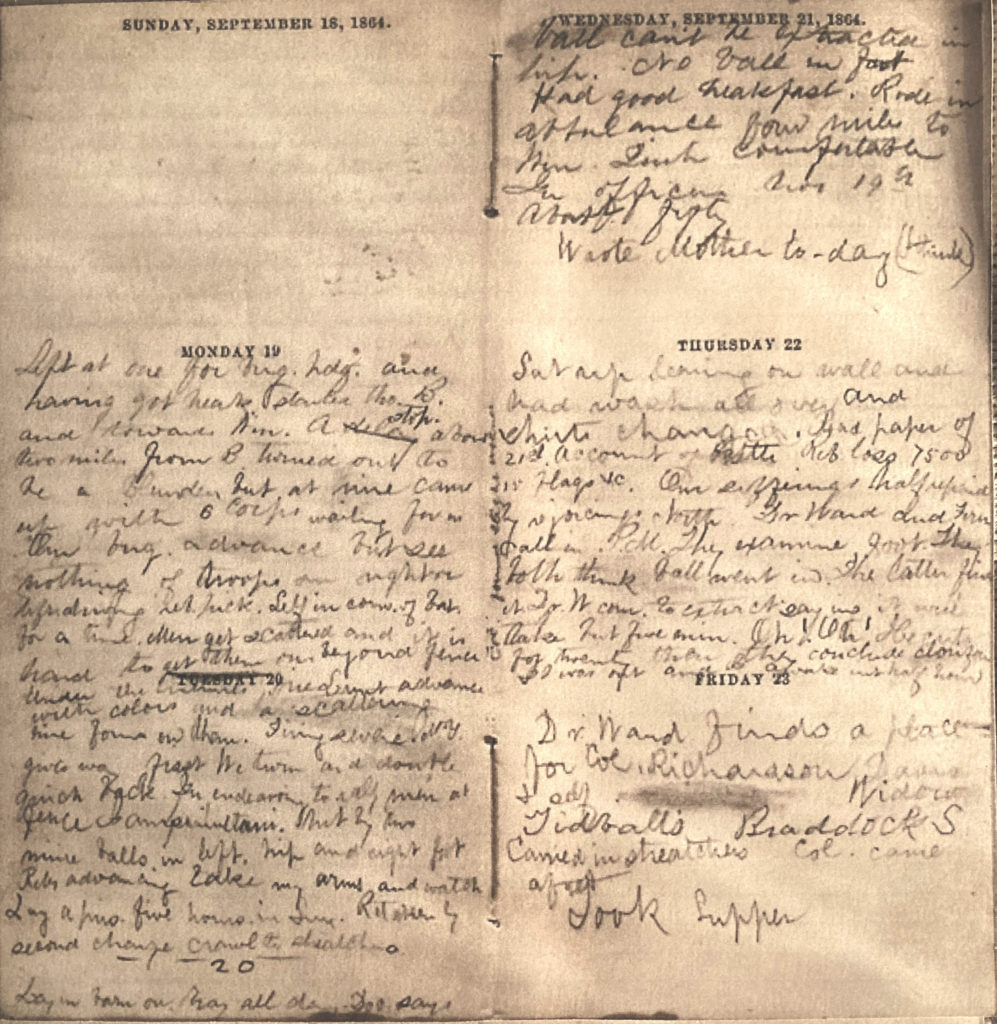
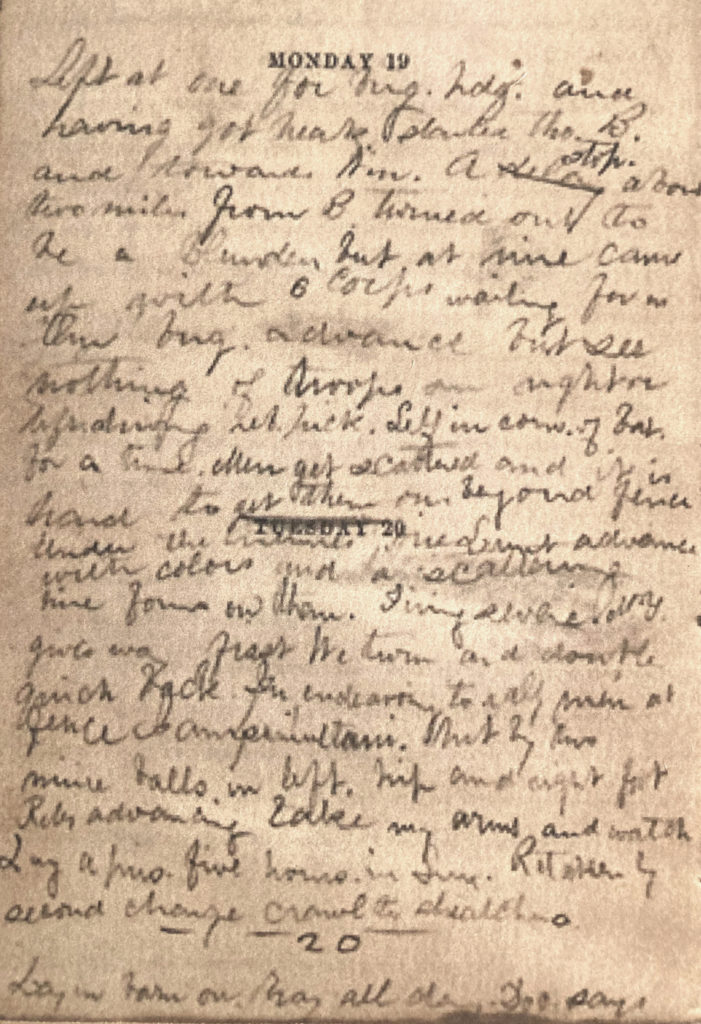
Monday September 19, 1864
Left at one for brigade headquarters, and having got near started the B. (battle?) and towards Winchester. A delay stop about two miles from B. turned out to be a blunder but at nine came up with 6 Corps waiting for us. Our brigade advanced but see nothing of troops on right or left. Driving back rebel pickets. Left in corner of battle for a time. Men get scattered and it is hard to get them on beyond fence. Under the constant fire Lunt advanced with colors and a scalding fire pour on them. Firing severe along gives way. First we turn and double quick back. In endeavoring to rally the men at fence I am. ? hit by two minie balls in left hip and right foot. Rebs advancing take my arms and watch. Lay a prisoner five hours in sun. Retaken by second charge crawl to stretcher.
(September 20 & 21, 1864)
Lay in barn on hay all day. Doc says ball can’t be extracted in hip. Had good breakfast. Rode in ambulance four miles to a Winchester. Quite comfortable. Ten (?) officers our 19th about fifty. Wrote Mother to-day (I think)
Thursday, September 22, 1864
Sat up leaning on wall and had wash all over and shirt changed. Had paper of 21st account of battle. Reb loss 7500 15 Flags &c. Our suffering half paid by rejoicing North. Dr. Ward and Fern call in P.M. They examine foot. They both think ball went in. The latter finds it. Dr. W. comes to extract it saying it will take but five min. Oh! Oh! He cut for twenty then they conclude clozure [sic]. I was up out and awake in a half hour.
Friday, September 23, 1864
Dr. Ward finds a place for Col. Richardson, Davis & Adj., Widow Tidballs, Braddock carried in stretchers. Col. came afoot. Took supper.
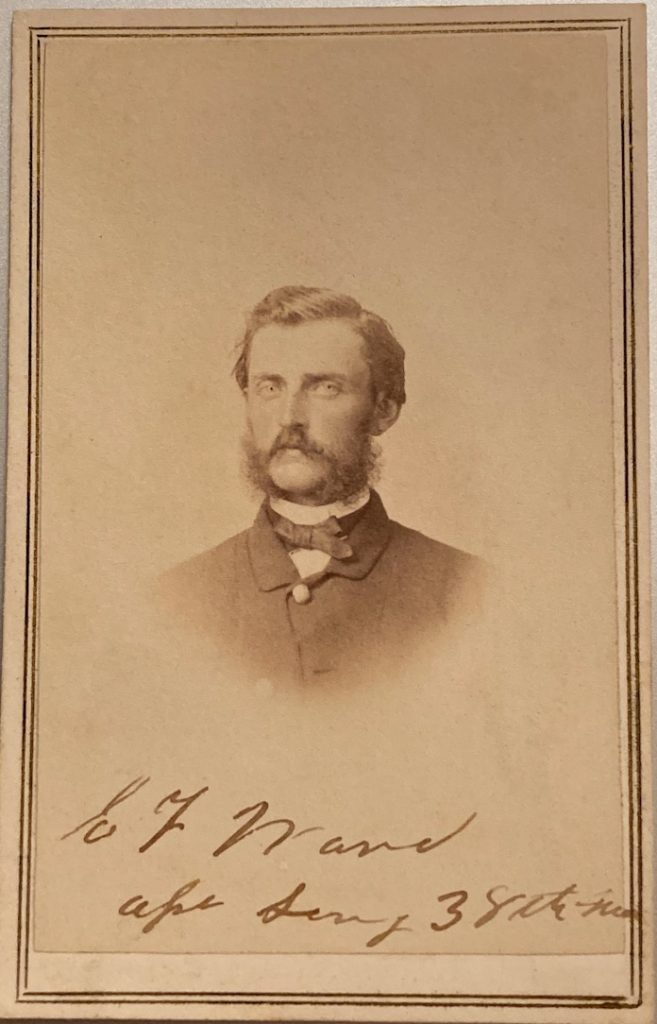
EDWIN FLETCHER WARD, M.D.
SURGEON 38TH MASSACHUSETTS INFANTRY
(personal collection)
Edwin Fletcher Ward was born about 1836 in Norwich, Connecticut, one of five children born to Windsor Ward, a Methodist clergyman, and his wife Lydia Harvey. Edwin’s youngest brother was named Amasa Ward. Edwin received his medical degree in 1861, from the College of Physicians and Surgeons at Columbia University in New York.
Edwin and Amasa resided in Worcester, Mass. when the Civil War broke out. Edwin worked as a physician and his younger brother was a druggist. On August 24, 1862, Edwin was commissioned Assistant Surgeon of the 38th Mass. Infantry, and Amasa enlisted as a Hospital Steward. Samuel C. Hartwell, the regimental surgeon, resigned due to disability on March 2, 1863 , and Ward was promoted to Surgeon. He was in charge of the hospitals at Port Hudson and Winchester, and was on detached service in the Shenandoah Valley in Spring and Summer of 1864. Both brothers survived to the conclusion of the war. Edwin was mustered out June 30, 1865 at Savannah, Georgia and Amasa followed suit on July 14, 1865.
Following his discharge, Edwin married Abbie L. Sweetser on November 2, 1865, and they had two children. He maintained a successful medical practice and the family resided on the Upper West side of Manhattan. He remained active in alumni affairs, and died on November 23, 1912 at the age of 76.
MEDAL OF HONOR WINNER ALPHONSO M. LUNT
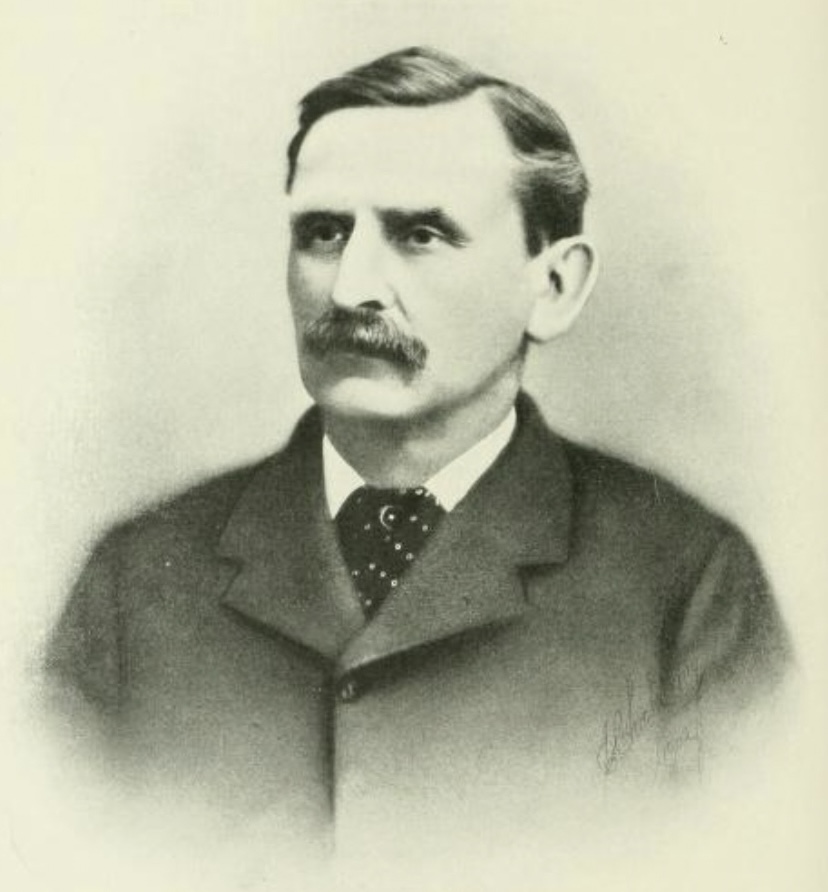
According to a short bio in the book “Ancient Middlesex with Brief Biographical Sketches…”:
At the battle of Opequon, September 19, 1864, Sergeant Lunt was in command of the color guard, and personally bore the national flag throughout the engagement. At one time, the rebel line of battle, carrying several battle flags, were within talking distance, and although the whole of his color guard was swept away, and for awhile he stood alone amid the dead and wounded, under a tremendous fire from ten times the number of the Union forces, still he remained where he had been placed by his colonel as steadily and bravely as though on parade…during this stand, twenty-two bullets penetrated the flag and the brass lance at the top of the shaft was shot away… In 1891 he was awarded… a “Medal of Honor” upon which is inscribed the following:
“The Congress to Sergeant Alfonso M. Lunt, Company F, 38th Mass. Vol’s, for
most distinguished conduct at the battle of Opequon Creek, Va., Sep. 19th, 1864.”
WILLIAM H. WHITNEY AFTER THE CIVIL WAR
Whitney returned to work at the same firm in Boston as before the war, until 1871. He married his longtime sweetheart, Emma Sargent Barbour, in 1868 and they had two children. He eventually opened his own civil engineering firm, over time becoming an accomplished engineer and surveyor. In 1881 he was formally recognized for his achievement in improving the process by which blueprints are made, and in 1883, compiled an atlas of maps in a folio called “Union and Confederate Campaigns in the Lower Shenandoah Valley” subtitled “Twenty years after – at the first reunion of Sheridan’s Veterans on the fields and in the camps of the valley.”
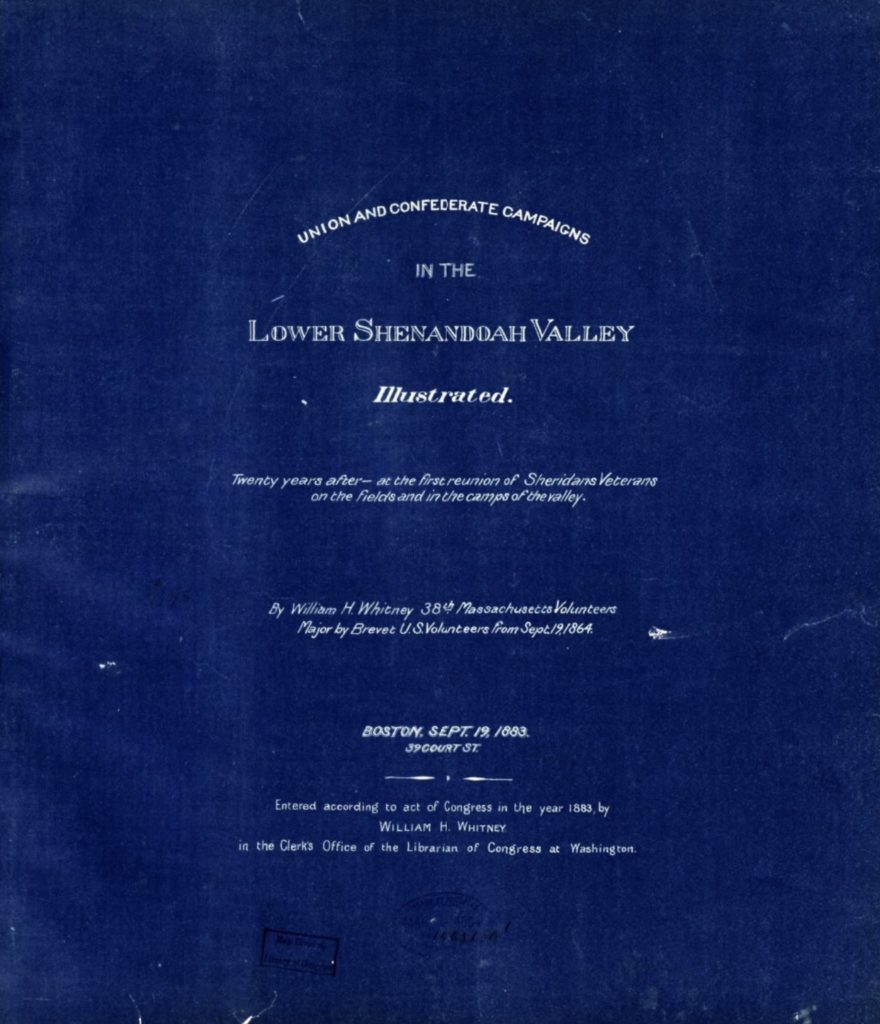
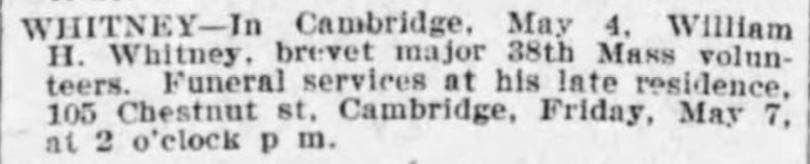
Whitney had a variety of interests apart from the scientific world. Harboring an interest in both genealogy and history, he was involved in local societies as well as the GAR and authored a history of the Whitney family titled “A Watertown Farm in Eight Generations” in 1898. He dabbled in politics, and served on the Board of Health. He died on May 4, 1909 of a cerebral hemorrhage after a long illness and is buried in Mount Auburn cemetery in Cambridge.
His obituary was listed in The Boston Globe on May 5, 1909:
His death certificate:
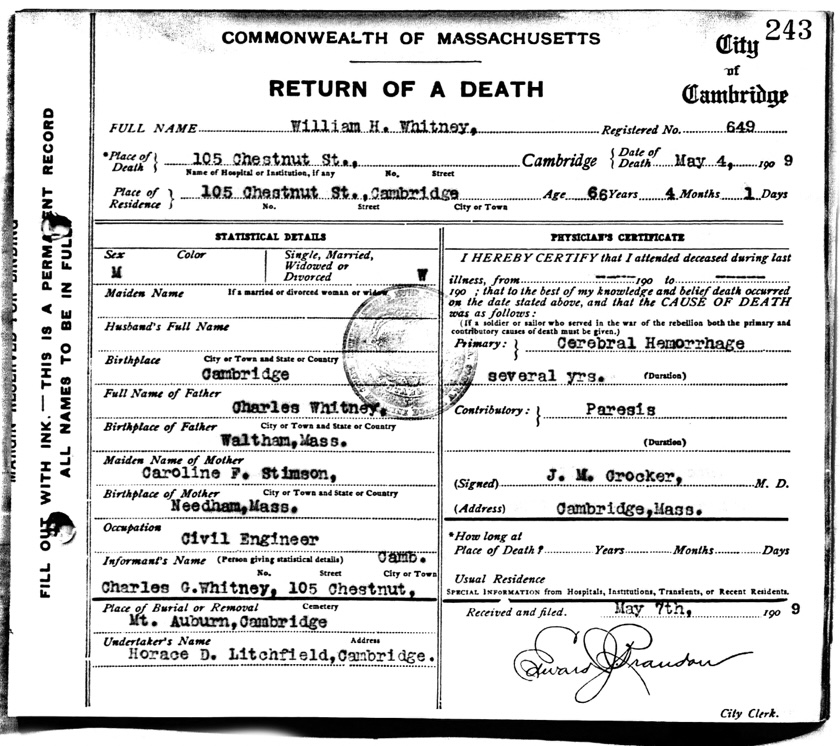
He is buried in Mount Auburn cemetery in Cambridge, Massachusetts.