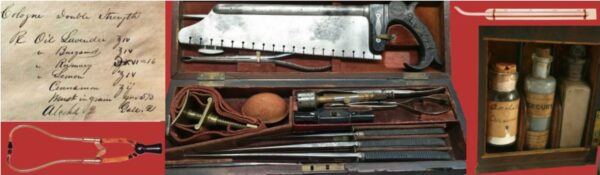
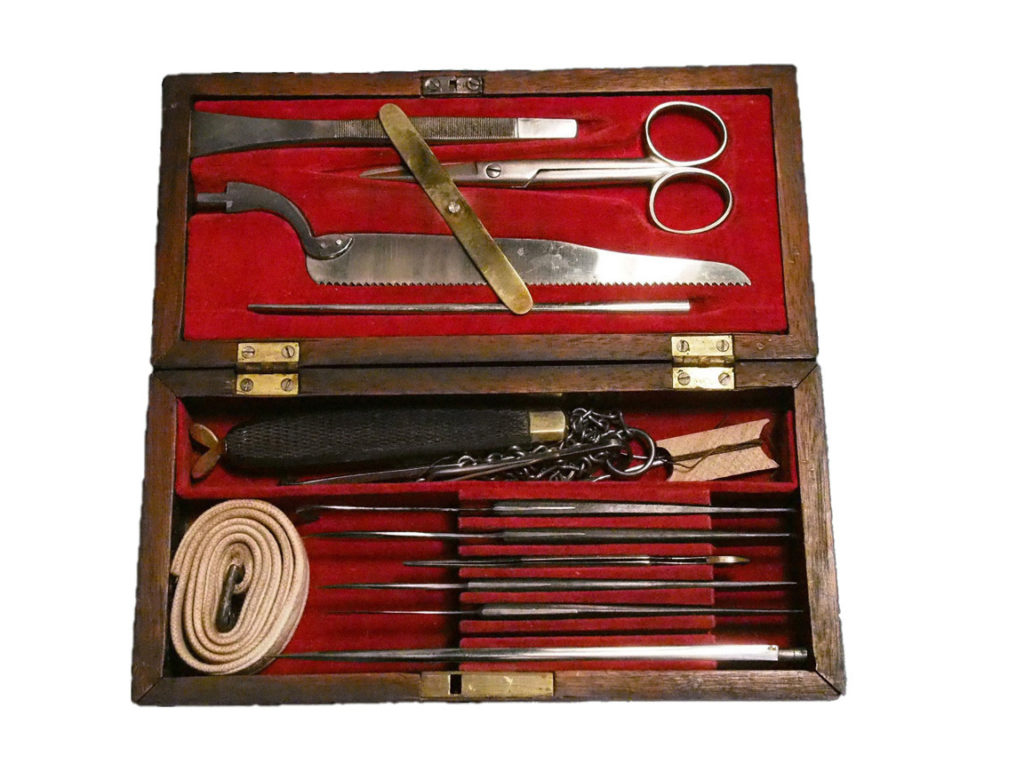
This Civil War-era post-mortem set was made by the premier surgical instrument maker in New York, George Tiemann. It was designed according to the specifications of Thomas Constantine Finnell, M.D., a renowned New York pathologist.
Finnell’s post-mortem sets were made in two sizes, small and large. The large set contained everything in the small set with the addition of an enterotome and a steel hammer. The example shown is the small size, and contains the following instruments:
1 Finnell’s Amputating knife and saw
1 Handle to fit the above
3 scalpels of assorted sizes
1 Cartilage knife with steel handle
1 Pair of straight dissecting scissors
1 Tenaculum
1 Triple chain with hook
1 Chisel
1 German silver blowpipe
1 Pair of dissecting forceps
Needles and thread
1 Rosewood case with lock and key lined with velvet
The instruments are all original to the set with the exception of the dissecting scissors. Although it is not marked “U.S. Medical (or Hospital) Dept.”, this set is considered to be a military-issued set based upon the military-style sliding latch (absent on civilian sets, which had a single keyed lock). It was made by George Tiemann, who had the largest government contract for supplying medical and surgical instruments during the Civil War, and the address of “67 Chatham St.” dates it to the later war years, specifically the 1864 – 1865 time period. The brass plaque on the lid is not engraved, which would be unusual for a military-issued set. It is possible that the set was never used.
POST-MORTEM EXAMINATIONS DURING THE CIVIL WAR
Surgeon General William Hammond issued Circular No. 2 May 21, 1862, which provided for the establishment of the Army Medical Museum. The museum was created to teach physicians the basic principles of military medicine. Circular No. 2 directed medical officers to “diligently collect and forward to the office of the Surgeon General all specimens of morbid anatomy, surgical or medical, which may be regarded as valuable; together with projectiles and foreign bodies removed; and such other matter as may prove of interest in the study of military medicine and surgery.”
At the beginning of the American Civil War, most surgeons had little to no experience treating bullet wounds, camp, and hospital diseases. The Army Medical Museum was created to teach physicians the basic principles of military medicine by “illustrating the injuries and diseases that produce death or disability during war, and thus affording materials for precise methods of study or problems regarding the diminution of mortality and alleviation of suffering in armies.”
The most effective vehicle for the transmission of this knowledge to the large body of American physicians was the Civil War case report. Thus Hammond issued Circular No. 5 shortly after Circular No. 2, which required that all physicians write and submit a case history or essay along with each specimen or photograph that was submitted to museum. The Circular requested that, “All medical officers cooperate in this undertaking by forwarding to this office such sanitary, topographical, medical and surgical reports, details of cases, essays and the results of investigations and inquiries as may be of value for this work, which full credit will be given in forthcoming volumes.” Circular No. 5 and the subsequent publication of the Medical and Surgical History of the War of the Rebellion, published both case histories and visual representations of the wartime cases. The case history was important—it was meant to standardize the experience of the observer and reinforce the diagnosis of the expert.
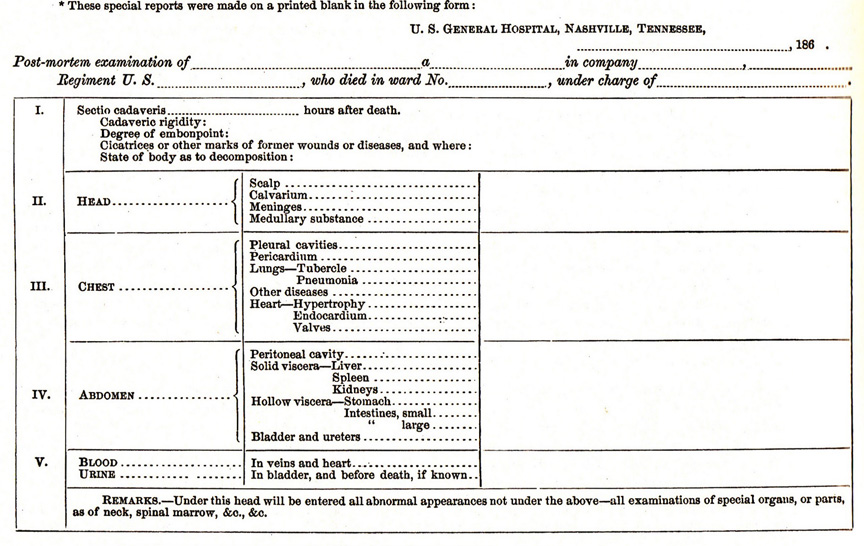
(from Dr. Michael Echol’s website medicalantiques.com)
The process of collecting medical and surgical specimens and the collection itself allowed for the creation of new forms of analysis, a new way to think about diseases and wound trauma, and this promise for medicine had a profound effect on the individual physician. Displayed alongside medical and surgical specimens and photographs, the case history established a relation between the visual representation of disease and the physician’s analyses of specimens, tissues and organs. There was now a specific medical model: physicians were required to diagnose, treat, monitor, and perform an autopsy culminating in the relationship with the body with the delivery of the case report and specimen or photograph to the Army Medical Museum. Both circulars gave physicians unprecedented access to specimens and bodies on a scale never before experienced in American medicine and created new opportunities in which to develop ideas about medicine and disease.
The extent of the materials received was enormous – medical section curator Joseph Woodward recalled years later “that the records thus accumulated embraced over sixteen thousand folio volumes of manuscript record books” and “several tons of manuscript reports and papers.” Once the project got underway, American physicians saw the museum as a new source of medical vitality, a center of learning that could institutionalize pathology and lay the foundation to both reform and develop American medicine along more scientific guidelines. The thousands of case reports, records, and specimens received served to form the basis for what would later be known as the Armed Forces Institute Of Pathology.
There was unparalleled loss caused by the Civil War. Throughout the war and after, Americans began the uneasy process of defining a new relationship with death, and the “living had to find meaning in the dead.” The museum was one way to make sense of the death, to find larger meaning in it, or to imbue the war dead with a sense of national importance. Hammond noted, “…It is scarcely necessary to remind the medical officers of the regular and volunteer services that through the means in question much may be done to advance the science which we all have so much at heart, and to establish landmarks which will serve to guide us in the future.”
THOMAS CONSTANTINE FINNELL, M.D.