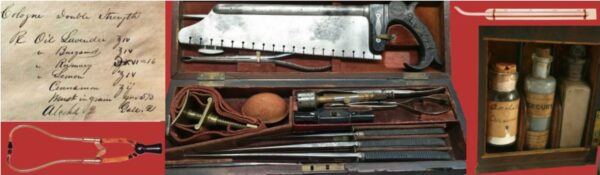
OWNED BY DR. FELIX SAEYS, A PHYSICIAN IN A BELGIAN ASYLUM
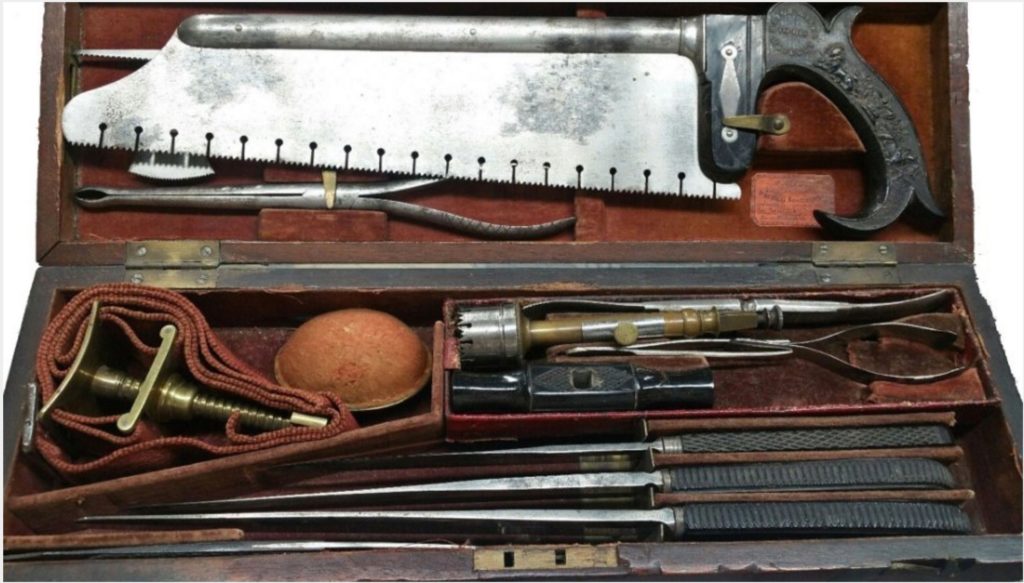
This set is remarkably complete. Unlike the other, earlier Weiss set, this set contains Weiss’ improved capital amputation saw, first introduced in 1831. This saw has fine teeth interspersed with deep slots, to prevent clogging with bone dust during operation. The saw is also now boldly marked with Weiss’s claim as “Razor Makers to His Majesty,” reflecting his appointment to that position by King William IV. Weiss moved shop to the 62 Strand location in London in 1836, and by 1841 the business was styled as “Weiss & Son”.
Weiss, who for several decades was arguably the premier instrument maker in London, was a native of Austria, and finally applied for British citizenship in 1827, after living in England for some 31 years.
The firm still operates as “John Weiss & Son, Ltd.” but is now located outside of London and is no longer owned by the family.
Weiss amassed a considerable fortune during his life, yet had a morbid fear of being buried alive. To guard against this eventuality, he fashioned an instrument to penetrate his heart when the coffin was closed. Detailed instructions to this end were left in his will. John Weiss died on 26 December 1843 and was buried in the churchyard of St. Nicholas’ church in Brighton, with his surgeon Benjamin Vallance in attendance to carry out his wishes
DR. FELIX SAEYS (1838 – 1882)
This set was owned by a “Docteur F. Saeys” of Bruges, Belgium as is inscribed on the brass straps on the cover of the case. Dr. Felix Dominique Adolphe Saeys was born June 19, 1838 in Bruges and died in 1912. Research uncovers that Dr. Saeys was appointed a “medecin-adjoint” (assistant medical officer) on April 29, 1882, of the Asylum of Saint-Dominique near Bruges. Unfortunately, his father was NOT a physician, which might have explained how he came to own this older set of instruments. One possibility is that Dr. Saeys was given this set by a physician he succeeded at the asylum, or by his superior at the time he began his employment there. For more information on Dr. Saeys and the Asylum of Saint-Dominique (types of patients, etc.) click the buttons below.
THE ASYLUM SAINT-DOMINIQUE
I could find little online about the hospital where Dr. Saeys served as physician. What I could find is noted below.
An asylum for the “insane of both sexes”, St. Dominique was founded in a building that formerly was a convent, built in 1546. The asylum had existed since at least 1806, but the inmates were transferred to the convent building in 1834.
In the 1874 book “Manual of Lunacy” , it states the Hospital of Saint-Dominique is located in Bruges, and its patients are “pensioners and poor patients of both sexes.”