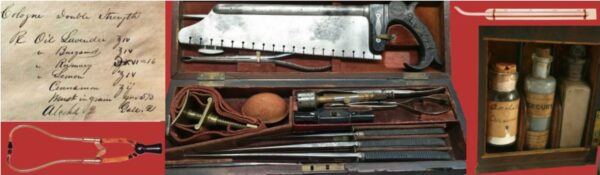
ATTRIBUTED TO GEORGE WYMAN FAY, M.D.
AND LATER USED BY HIS SON, FRANK GLEASON FAY, M.D.
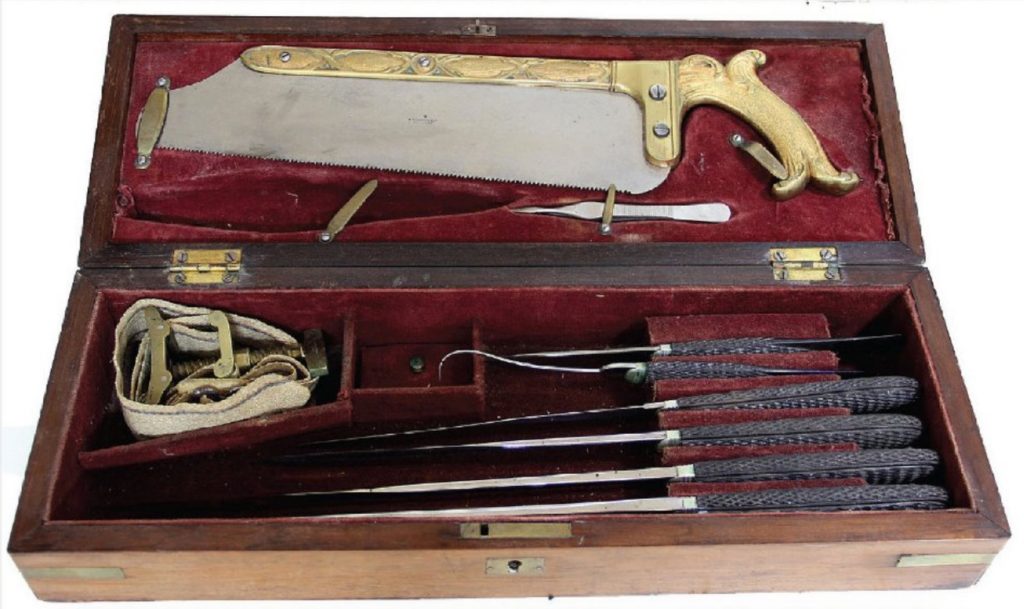
This set reflects the high standard of quality Goulding imparted to every piece he manufactured. The amputation saw has a high-art brass spine and handle – meant to imitate the short Infantry sword – an element unique to Goulding. The set is missing the bone forceps; all instruments are stamped “W.R. Goulding & Co. New-York” with the exception of the tourniquet, which is marked “H. Hernstein & Son” (Civil War era).
While the set itself is undoubtedly pre-Civil War era, the Old English font inscription style on the cartouche obviously post-dates the age of the set. A likely explanation is that the set was handed down from the original owner to another physician.
A thorough review of both the US Census records (from 1860 – 1910), and the AMA Directory of Deceased Physicians shows only two possibilities for a physician with the initials “F. G. Fay”. One is Franklin Goble Fay, who was born in Illinois in 1859 and got his degree from Chicago’s Bennett College of Eclectic Medicine and Surgery in 1886, and whose father was not a physician. The only other possibility is Frank Gleason Fay, the son of Dr. George Wyman Fay who was a noted physician in Worcester, Massachusetts. The younger Fay’s medical preceptor was his father, and as Frank received his M.D. from Brooklyn’s Long Island Medical College in 1884, it is quite plausible that this set was presented as a graduation gift to him and inscribed with his name at that time.
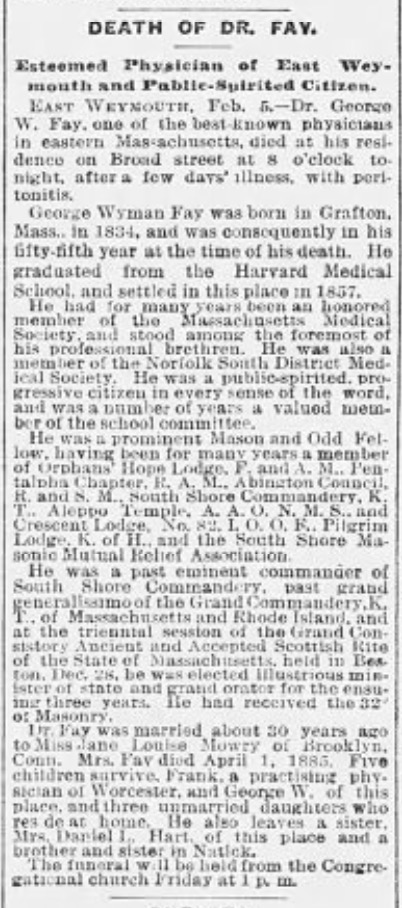
GEORGE WYMAN FAY, M.D. (1834 – 1889)
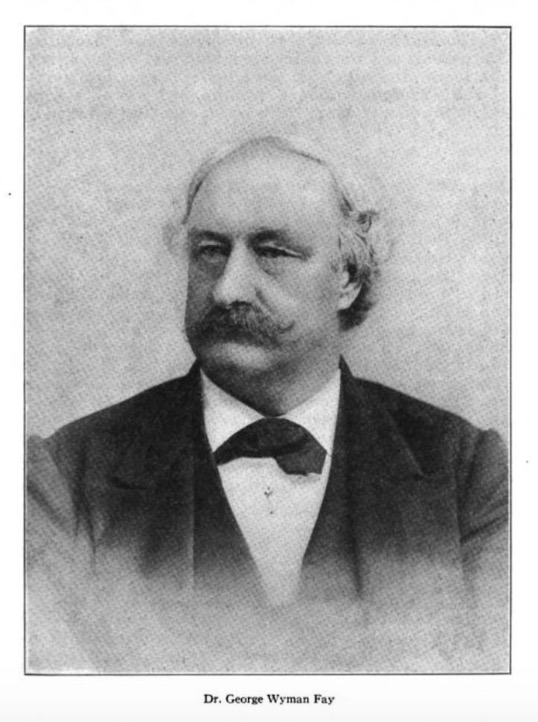
A native of Grafton, Massachusetts, George attended medical lectures at Harvard, then at Worcester where he earned his M.D. degree in July of 1862.
(n.b. An online biography states he graduated from Harvard Medical School in 1862, but Fay states otherwise in his application below.)
Civilian physician/surgeons who wanted to volunteer for naval duty during the Civil War were required to submit an application to the to the U. S. Navy Examination Board for a position as a medical officer in the Federal Navy. Some applicants failed to pass and did not serve, or served in the Union Army as contract physicians.
Contract physicians, also known as Acting Assistant Surgeons, were civilian physician/surgeons who volunteered their services during the Civil War. There were a total of 5,532 Acting Assistant Surgeons, most of whom worked in the general hospitals in the North, as well as continued their civilian practice. They held no commission but received pay as first lieutenants.
I own Dr. George W. Fay’s original application. It was submitted to the Federal Navy Board in Charlestown, Massachusetts, and is dated September 10, 1862:
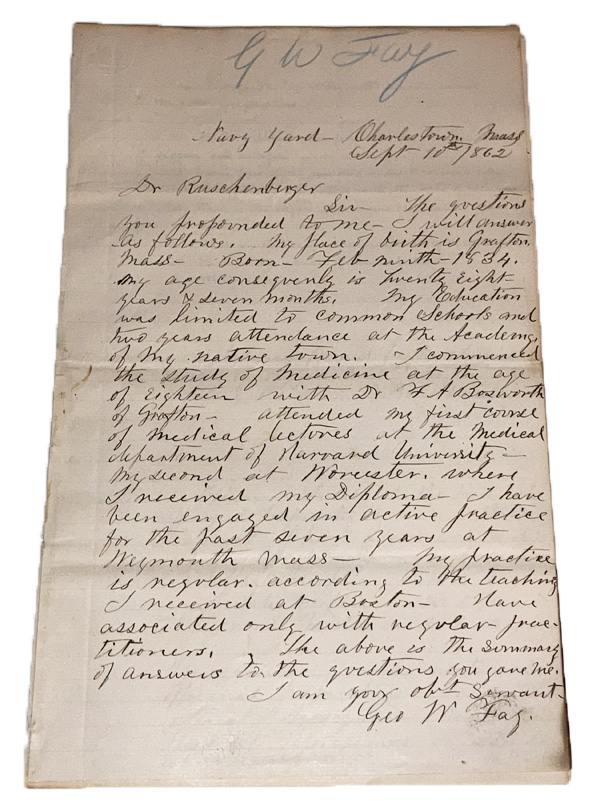
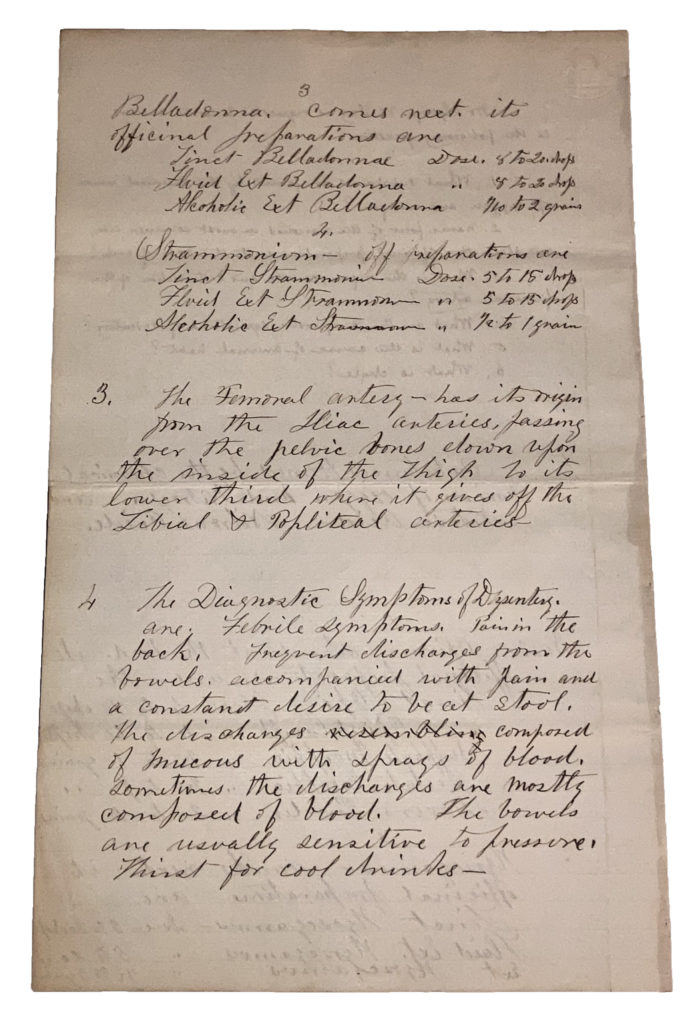
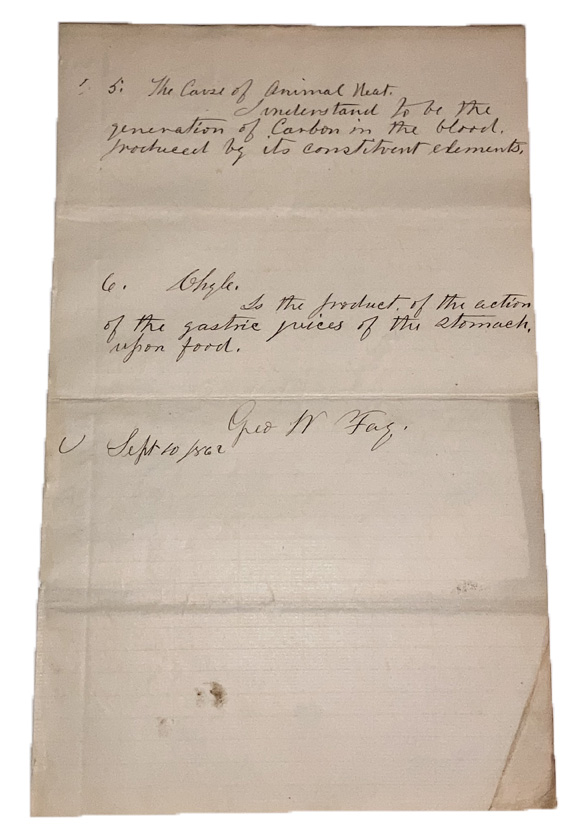
Whether Dr. Fay was vetted by the Naval Board, or whether he worked as a contract surgeon is not known. There is nothing in his obituary or biography that mentions any service during the Civil War.
OBITUARY OF DR. GEORGE WYMAN FAY
Published in The Boston Globe, February 8, 1889
FRANK GLEASON FAY, M.D. (1859 – 1933)
Although the son followed his father’s footsteps in his choice of profession, his own obituary would seem tragic compared to the illustrious tribute given to his father.
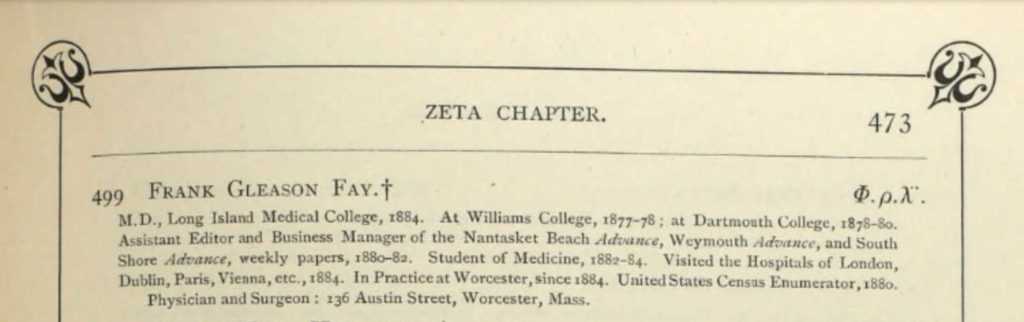
Dr. Frank G. Fay was the son Dr. of George Wyman Fay, and served as his preceptor. Born in 1859 in Weymouth, Massachusetts, he attended Williams College, and took classes at Dartmouth. His medical education was listed as “preceptor, George Wyman Fay (his father) and Maine Medical College, one year.” He earned his M.D. degree at Brooklyn’s Long Island Medical College in 1884. After graduation he took a lengthy trip abroad during which he visited the hospitals of major European cities. He returned to Worcester and opened his practice there – as a “Physician and Surgeon”. In November of 1884, he married Brooklyn-born Mary Isabel Meacham, and they had one child, George Wyman Fay, born in June 1892.
He became a member of the Massachusetts Medical Society, and he and his wife spent summers at Chatham on Cape Cod. Newspaper accounts from 1897 and 1913 mention them in the society columns, throwing whist parties at a fancy hotel, staying at a summer cottage etc. For 30 years, he had a medical practice and was to all appearances, a successful physician.
A SAD TURN OF EVENTS
Things were not as well as they appeared. Two years later, in June of 1915, this notice appeared in the Boston Globe:

Frank and Mary divorced, and four years later, in July 1919 in Portland, Maine, 60-year old Dr. Fay married Cora B. Clough, who was 41. Cora had grown up in a large Victorian home that was only 200 feet from the Fay household. After their marriage they lived in that home with her brother, John Clough, a lawyer, and Frank continued his medical practice.
That union did not last long, and four years later his life again took a downward turn. In 1923 he was admitted to Lawton Hall, (AKA “Vermont Lunatic Asylum”), located in Brattleboro, Vermont. Built in 1834, it is better known as Brattleboro Retreat, a facility to treat mental health disorders and drug addiction. Whether Dr. Fay had either, or both, of those problems is not known. He was there long enough to recover and eventually become employed as a physiotherapist at the facility.
By July 1927, he was well enough to leave the Retreat and return to Cape Cod for part of the summer. He moved to Randolph, Massachusetts in 1929, and for the last 4 years of his life, made his home with a man named Ralph K. Corliss, who was very active in the local I.O.O.F. (Odd Fellows fraternity).
In the 1930 census, he is living as a “boarder” in Randolph, Massachusetts, residing with Corliss. He does not list any occupation, and answered “no” to attending school. He states he is a widower (yet Cora was still very much alive). He died in Massachusetts General Hospital on August 31, 1933 at age 71. His obituary lists one surviving relative, son John W. Fay of Torrance, California. (n.b. The name should be George, not John). Cora died nine months later in Worcester, Massachusetts at age 56. She is buried with her parents and siblings.
OBITUARIES OF DR. FRANK GLEASON FAY
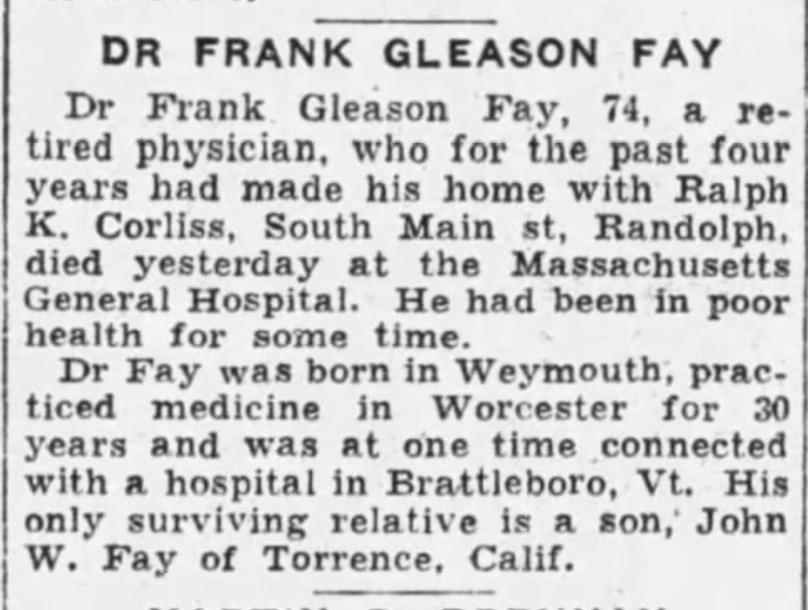
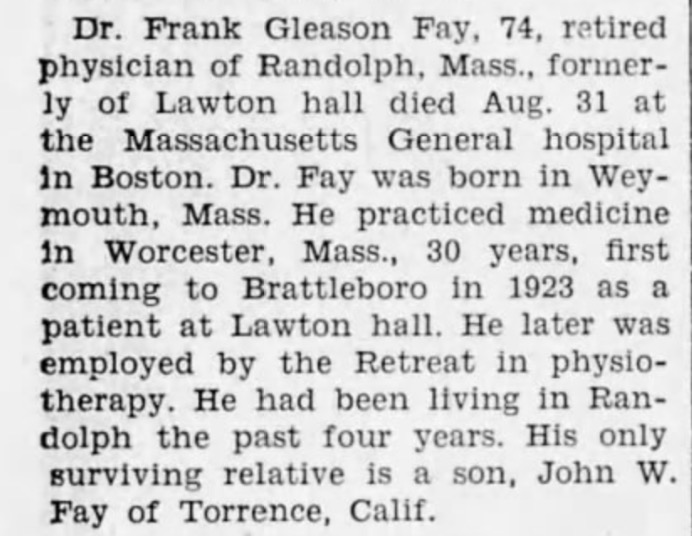
From “The Boston Globe”, Boston Mass.
September 1, 1933
From “The Vermont Phoenix”, Brattleboro, VT
September 8, 1933
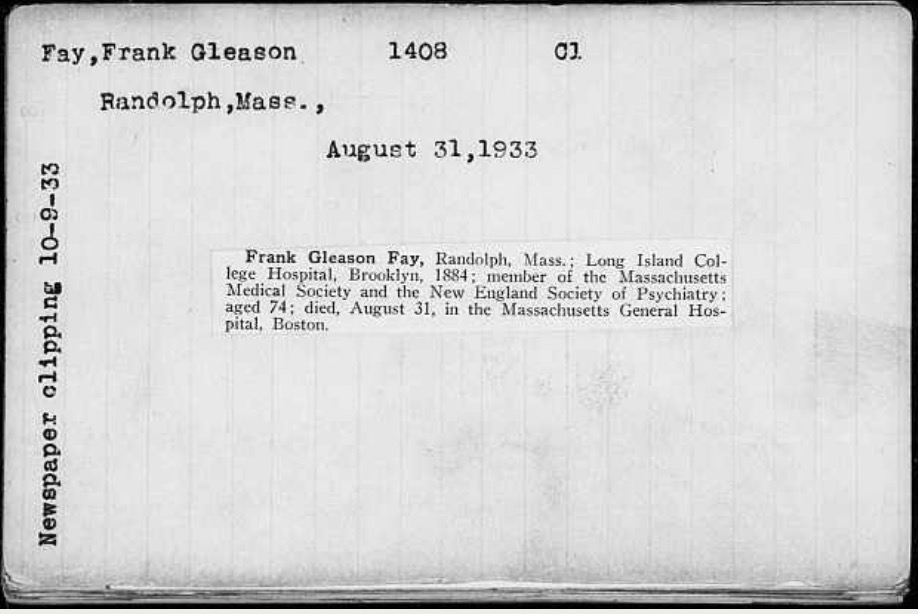
The 1933 (Vol. 10) edition of JAMA (the Journal of the American Medical Association) has a terse obituary for Dr. Fay, cut out and pasted on his card in the AMA Directory of Deceased Physicians file:
Dr. Frank Gleason Fay’s burial site remains unknown.